Views: 0 Author: Site Editor Publish Time: 2026-09-23 Origin: Site
Warehouse square footage costs are escalating rapidly. Facility managers face intense operational pressure to maximize vertical storage in narrow aisles without expanding the physical footprint. Equipment budgets remain tight across the board. A massive operational gap exists on the warehouse floor. Manual pallet jacks lack vertical lifting capabilities, leaving upper racking empty. Full-sized forklifts demand excessive capital, require high maintenance, and need wide aisles to maneuver safely. The strategic middle ground is the Pallet Stacker. This equipment bridges the divide between basic horizontal transport and heavy-duty vertical lifting. Evaluating the right type—from manual units to fully motorized walkie models—optimizes space utilization. It improves facility safety and lowers overall operational expenses without inflating equipment budgets.
Strategic Positioning: Pallet stackers bridge the gap between basic pallet jacks and traditional forklifts, offering vertical lifting capabilities in tight, narrow-aisle environments.
Fleet Optimization: Integrating stackers reduces reliance on full-sized forklifts for light-to-medium tasks, freeing up heavy-duty equipment for operations that strictly require them.
Categorical Options: Solutions range from manual hydraulic units for low-volume tasks to fully electric walkie stackers designed for high-cycle, multi-shift operations.
Cost-to-Value Ratio: Deploying stackers reduces capital expenditure, lowers maintenance costs, and offers operational simplicity with less stringent operator certification compared to ride-on forklifts.
Infrastructure Dependency: Successful implementation requires specific facility conditions, including smooth, level flooring and appropriate pallet types (e.g., open-bottom vs. closed-bottom pallets dictating straddle vs. fork-over designs).
A pallet stacker is a compact material handling machine. Operators control it as pedestrians walking behind the unit or as stand-on riders. Engineers designed it specifically to lift, transport, and organize palletized goods efficiently. It serves as a dedicated solution for moving loads vertically into racking systems. The design prioritizes a small footprint and tight maneuverability. Facilities utilize them when full-sized ride-on equipment is unnecessary, impractical, or physically impossible to fit between racking rows.
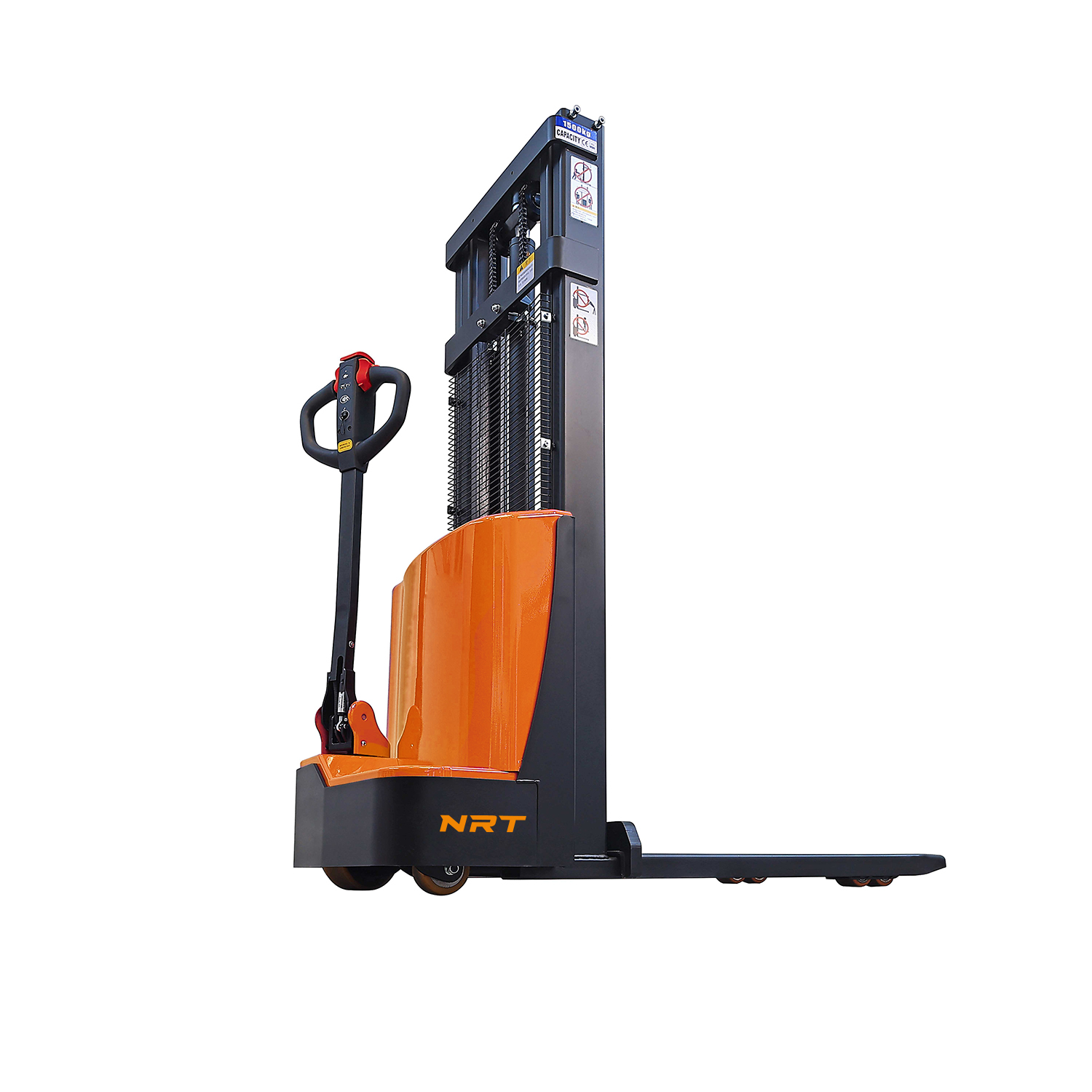
The core components define the capability of the machine. Understanding these parts helps operators and fleet managers maintain the equipment properly.
The Mast: This vertical structure provides the reach required for racking. Masts come in single (simplex), two-stage (duplex), or three-stage (triplex) configurations. Single masts offer excellent operator visibility but limited lift height. Two-stage masts provide higher reach with a free-lift cylinder, allowing the forks to rise without the mast channels extending immediately—perfect for low ceilings. Three-stage masts reach the highest racking tiers.
The Forks: Heavy-duty steel prongs that support the palletized load during transit. They slide directly into the pallet pockets.
The Steering Tiller: This control arm houses the interface for driving and lifting. It typically includes a throttle thumbwheel, lift/lower buttons, a horn, and a belly-button reversing switch for safety.
The Lift Mechanism: Hydraulic cylinders, powered either by a manual pump or an electric motor, drive heavy-duty chains that elevate the fork carriage along the mast channels.
Stackers and forklifts serve different operational scales. Forklifts utilize a heavy rear counterweight to balance front loads. This requires a massive chassis and a wide turning radius. Stackers distribute weight over front support legs. This eliminates the need for a massive counterweight. Stackers navigate aisles as narrow as seven feet. Forklifts typically require twelve to fourteen feet of aisle clearance. Stackers bring simplicity to daily logistics tasks. They consume less energy and require less preventative maintenance.
Pallet jacks and stackers both transport goods horizontally across warehouse floors. However, only stackers possess a mast for vertical positioning. Pallet jacks lift loads just a few inches off the ground to clear the floor. Stackers elevate loads several feet into the air. If your operation requires placing pallets onto elevated racks, a pallet jack is insufficient. A stacker provides the necessary vertical lift while maintaining a similar pedestrian-operated footprint.
Feature | Pallet Stacker | Standard Forklift | Manual Pallet Jack |
|---|---|---|---|
Vertical Lift | Medium to High (up to 180+ inches) | High to Very High | Minimal (Floor clearance only) |
Aisle Requirement | 6 to 8 feet | 12 to 14 feet | 4 to 6 feet |
Operator Position | Pedestrian Walkie or Stand-on | Seated Ride-on | Pedestrian Walkie |
Primary Use Case | Narrow aisle racking, medium throughput | Heavy loads, high throughput, outdoor yards | Horizontal transport, loading docks |
Floor Surface | Smooth indoor concrete only | Indoor concrete, outdoor asphalt, rough terrain | Smooth indoor concrete, truck trailers |
Manual stackers rely entirely on human power. Operators use a hydraulic hand-pump or foot-pedal to elevate the forks. Pushing and pulling the machine transports the load horizontally. These units are ideal for low-volume operations. They suit environments requiring only occasional vertical lifting, such as a small auto parts stockroom or a localized maintenance shop. Highly budget-constrained facilities benefit from their low acquisition cost. However, physical limitations exist. Operator fatigue sets in quickly during repetitive tasks. Lift speeds are significantly slower than motorized alternatives.
Semi-electric stackers offer a hybrid material handling solution. They feature an electric lift motor combined with manual push-pull transit. This design delivers a strong return on investment for specific workflows. Vertical stacking is much faster than manual units. The electric motor eliminates the physical strain of pumping a hydraulic cylinder. However, throughput remains limited. The operator must still use physical force to move heavy loads horizontally across the floor. They work best in tight staging areas where travel distances are under twenty feet.
Electric walkie stackers feature fully motorized drive and lift functions. Operators control all movements via a pedestrian tiller handle. This eliminates physical strain entirely. The 1.5 Ton Electric Walkie Pallet Stacker serves as a standard industry benchmark. It balances robust lifting power with a highly compact footprint. It excels in medium-duty warehouse applications. Continuous logistics operations rely on these units. Modern models integrate high-capacity batteries and AC drive motors to support full shift cycles without mid-day charging interruptions.
Ride-on stackers feature a folding platform and side restraints. Operators stand on this platform during longer transit distances. This reduces fatigue in large distribution centers where pallets must move across expansive floor plans. Counterbalance stackers represent a distinct design variation. They lack front straddle legs entirely. Instead, they use a heavier rear chassis to balance the load. This allows them to operate exactly like miniature forklifts. They easily handle closed-bottom pallets. They excel at loading docks where front support legs would interfere with dock plates or truck tailgates.
Warehouse space commands a premium. Facility managers must maximize racking density. Stackers feature an exceptionally tight turning radius. This allows facilities to shrink aisle widths significantly. Converting a twelve-foot forklift aisle into a seven-foot stacker aisle reclaims massive square footage. This reclaimed space accommodates additional racking rows. High-density storage becomes achievable without expanding the building footprint. You can store more inventory in the exact same warehouse shell.
Fast-paced third-party logistics (3PL) environments demand rapid material movement. Stackers play a critical role in these settings. They organize palletized goods efficiently. They maximize throughput in staging areas. Cross-docking requires moving goods directly from receiving to shipping without long-term storage. Stackers navigate congested staging lanes easily. Their pedestrian operation allows workers to maneuver safely around floor-loaded freight, shrink-wrap stations, and other personnel.
Standard flooring in retail environments often has strict weight limitations. Elevated mezzanines share these structural constraints. Heavy ride-on forklifts easily exceed the pounds-per-square-foot (PSF) limits of these floors. Stackers offer a lighter footprint. They distribute weight more evenly across their load wheels and drive tire. This makes them significantly safer for elevated storage areas, heavy industry catwalks, or retail backrooms. They provide vertical lifting power without compromising structural integrity.
Many facilities lack dedicated, raised loading docks. Loading and unloading delivery vehicles becomes a logistical challenge. Stackers provide a practical solution. They lift pallets directly from the ground level into the back of a box truck or van. Counterbalance stackers excel in this application. They approach the vehicle without straddle legs hitting the rear bumper or tires. This streamlines dock operations in unconventional facility layouts, such as urban distribution centers or street-level retail receiving bays.
Manufacturing and assembly lines prioritize ergonomics. Bending and reaching cause operator strain and lead to workplace injuries. Stackers function effectively as adjustable worktables. Operators raise the palletized materials to waist height. This keeps components within an ergonomic strike zone. As the pallet empties, the operator adjusts the fork height. This simple application prevents back strain, reduces worker compensation claims, and increases assembly line productivity when feeding machines like CNC routers or press brakes.
Acquiring material handling equipment requires significant capital. Stackers cost a fraction of traditional internal combustion or large electric forklifts. The operational overhead is also substantially lower. They consume less energy during daily operations. Maintenance requirements are minimal. There are no internal combustion engines to service. There are no complex transmission systems to rebuild. Fewer moving parts translate directly to reduced downtime and lower maintenance expenses. You replace contactors and load wheels instead of rebuilding engines and transmissions.
Space utilization metrics dictate warehouse profitability. Traditional forklifts require wide aisles to turn safely with a load. This wastes valuable floor space. Transitioning to stackers reclaims this wasted area. Shrinking aisles from twelve feet to seven feet increases total pallet positions. Facilities can delay costly building expansions or relocations. The equipment pays for itself simply through the real estate it reclaims.
Pedestrian-operated equipment inherently improves facility safety. Operators stand behind the machine, maintaining a clear line of sight. Forward visibility is vastly superior to a seated forklift operator peering through a mast and a heavy load. Travel speeds are mechanically limited to safe walking paces. This drastically reduces the risk of catastrophic collisions with racking or personnel. Furthermore, the tiller head features a belly-button reversing switch. If the operator is pinned against a wall, the switch hits their body and instantly reverses the machine's direction.
Regulatory compliance remains a priority for facility managers. OSHA requires formal training for all motorized material handling equipment under standard 1910.178. However, motorized stackers feature highly intuitive controls. The learning curve is remarkably short. Faster onboarding gets new employees productive quickly. The certification process for pedestrian walkie units is typically less rigorous than full forklift licensing. This operational simplicity reduces training bottlenecks in high-turnover environments.
Equipment selection begins with load data. Calculate the maximum weight of your heaviest pallets. Evaluate if a 1.5-ton capacity meets your peak operational demands. You must also understand load center derating. A stacker cannot lift its maximum capacity to its maximum height. As the forks rise, the safe lifting capacity decreases. For example, a machine rated for 3,000 lbs at a 24-inch load center might only safely lift 2,000 lbs at a 150-inch lift height. Consult the manufacturer data plate. Ensure the derated capacity at your highest racking tier exceeds your heaviest pallet weight.
Pallet design dictates the required leg configuration. This is a critical selection factor.
Straddle Stackers: Feature wide support legs. These legs wrap around the outside of the pallet. You must use straddle models for closed-bottom pallets like CHEP, PECO, or standard block pallets.
Fork-Over Stackers: Feature legs positioned directly under the lifting forks. They are only compatible with open-bottom pallets like standard Euro pallets or skids. Choosing the wrong leg design renders the equipment useless for your inventory, as the legs will crush the bottom boards of a closed pallet.
Assess your current material handling fleet. Equipment should complement existing assets. An Industrial Pallet Walkie Stacker Forklift maximizes overall warehouse productivity when integrated strategically. Use heavy-duty ride-on forklifts for unloading trucks and long-distance transport. Use walkie stackers for localized racking and staging tasks. This synergy prevents heavy equipment from being tied up on light-duty jobs. It optimizes workflow across the entire facility.
Power sources dictate operational uptime. Traditional lead-acid batteries cost less upfront. However, they require regular watering, equalization charges, and ventilated charging rooms. Lithium-ion batteries require a higher initial investment. They offer zero maintenance. They support opportunity charging during operator breaks. This allows a single lithium-ion battery to power a stacker through multi-shift operations without swapping power cells. You simply plug the machine into a standard wall charger while the operator eats lunch.
Mast selection impacts both reach and facility navigation. Single masts provide a clear view of the load. They are restricted to low-level lifting. Duplex and triplex masts reach higher racking tiers. However, you must evaluate your facility infrastructure. Measure your lowest doorways, overhead pipes, and HVAC ducts. Ensure the collapsed height of a multi-stage mast can safely navigate your facility without causing overhead collisions. A triplex mast might reach 180 inches, but its collapsed height must still clear your 84-inch pedestrian doors.
Stackers are strictly indoor machines. They utilize hard polyurethane load wheels and drive tires. These wheels require smooth, flat, concrete surfaces. They cannot navigate gravel, dirt, or uneven asphalt. Operating them on rough surfaces causes severe wheel chunking and destroys the bearings. Small floor cracks or expansion joints can trap the small load wheels. Facility floors must be well-maintained to ensure safe and efficient operation.
Pedestrian equipment moves at walking speeds, typically capping out around 3 to 4 miles per hour. Walkie stackers are inefficient for transporting goods across massive distribution centers. If an operator must move a pallet several hundred feet, a walkie stacker creates a throughput bottleneck. Ride-on forklifts or powered pallet trucks handle long horizontal runs much faster. Deploy stackers for localized vertical lifting rather than long-distance transit.
Ground clearance is minimal on standard stackers. This creates severe limitations on inclines. They are generally unsuitable for steep dock plates or warehouse ramps. The chassis will high-center at the crest of a ramp, leaving the drive wheel spinning in the air. The support legs will scrape the ground at the bottom of an incline. If your workflow involves steep gradients, standard stackers will fail to navigate the terrain.
Simpler mechanics do not mean zero maintenance. Establish a strict preventative maintenance schedule to protect your investment.
Daily: Inspect the polyurethane wheels for chunking or flat spots. Test the belly-button reversing switch.
Weekly: Check the hydraulic fluid levels. Inspect the lift chains for proper tension and signs of rust.
Monthly: Lubricate the mast rollers to prevent binding. Inspect the electrical contactors and wiring harnesses for wear.
Quarterly: Perform a full load test to ensure the hydraulic pump maintains pressure without drifting downward.
Audit your facility's pallet inventory immediately to determine if you require straddle or fork-over leg configurations.
Measure the width of your narrowest aisles and the height of your lowest doorways to ensure dimensional compatibility before purchasing.
Calculate the maximum weight of your heaviest loads to determine the necessary lift capacity, factoring in load center derating at your highest rack tier.
Request an on-site equipment demonstration to validate turning radius requirements in your specific racking layout.
A: A forklift requires a seated operator, uses a heavy rear counterweight, and needs wide aisles to turn. A pallet stacker is typically pedestrian-operated, uses front support legs instead of a massive counterweight, and maneuvers easily in narrow aisles. Stackers offer greater operational simplicity and lower capital costs.
A: Yes, if the stacker is motorized. OSHA and local regulatory bodies classify motorized walkie stackers as powered industrial trucks. Operators must receive formal training and certification. However, the training process is generally faster and less rigorous than licensing for a full-sized, ride-on forklift.
A: It has a maximum base capacity of 1,500 kg (approximately 3,300 lbs). However, capacity decreases as the forks elevate. This is called load center derating. Always check the manufacturer's data plate to confirm the safe lifting capacity at your maximum racking height.
A: Generally, no. Standard stackers feature hard polyurethane wheels and very low ground clearance. They are designed exclusively for smooth, flat, indoor concrete floors. Rough terrain, gravel, or wet asphalt will damage the wheels and cause the machine to get stuck.
A: Lift heights vary by mast design. Single mast models typically lift up to 60 inches. Two-stage (duplex) and three-stage (triplex) masts can reach heights from 118 inches up to 180 inches or more. Always verify your ceiling and doorway clearances before selecting a high-lift mast.
A: Walkie stackers require significantly less space than traditional forklifts. Depending on the specific model and the length of the pallet being carried, standard turning radius dimensions generally require aisles between 6 and 8 feet wide for safe operation.
A: A straddle stacker has wide front legs that wrap around the outside of the pallet, making it compatible with closed-bottom pallets. A fork-over stacker has legs positioned directly underneath the forks, meaning it can only lift open-bottom pallets where the forks and legs enter the pallet together.