Views: 0 Author: Site Editor Publish Time: 2026-10-09 Origin: Site
Balancing warehouse throughput demands with equipment budgets and worker safety presents a constant operational challenge for facility managers. Moving inventory efficiently from receiving docks to storage racks requires the right tools. Selecting the wrong material handling equipment directly creates operational bottlenecks. It increases operator fatigue, raises workplace injury rates, and wastes valuable capital expenditure on tools that do not fit the workflow.
A technical evaluation framework helps you choose between manual and powered material handling options. You must analyze facility size, load volume, and shift demands to make an informed decision. Relying on assumptions about equipment capabilities often leads to underpowered operations or over-engineered fleets. We will break down the mechanical differences, operational thresholds, and safety considerations to guide your equipment strategy.
Distance Thresholds: Manual models are optimal for travel distances under 40 feet; powered models are necessary for distances of 40 to 100+ feet to maintain throughput.
Ergonomics & Safety: Powered equipment drastically reduces operator strain, mitigating worker's compensation risks associated with heavy push/pull forces.
Power Evolution: Modern lithium-ion configurations have eliminated the maintenance overhead and charging delays of traditional lead-acid battery systems.
Manual pallet trucks form the backbone of countless retail and industrial operations. These units rely entirely on human kinetic energy and mechanical advantage. Understanding their core mechanics helps identify exactly where they excel and where they fall short on the warehouse floor.
The design centers on a straightforward hydraulic pump mechanism. An operator pumps the handle, forcing hydraulic fluid into a lift cylinder. This action raises the forks just enough to clear the floor. The simplicity of this design makes these units incredibly reliable. There are very few moving parts to fail. Routine maintenance usually involves simple lubrication at grease zerks, checking hydraulic fluid levels, and occasional wheel replacements.
Wheel material selection heavily influences manual performance. Nylon wheels offer low rolling resistance, making heavy loads easier to push from a dead stop. However, they are loud and prone to chipping on rough concrete. Polyurethane wheels provide a quieter ride and better grip on slick floors, though they require slightly more initial push force. You must match the wheel compound to your specific floor conditions.
Certain environments are perfectly suited for this equipment. Retail backrooms often feature tight aisles where large motorized units cannot maneuver. Low-volume staging areas, where pallets move only a few feet from a staging lane to a stretch wrapper, benefit from the immediate availability of manual units. You never have to wait for a battery to charge. They are always ready for deployment.
Environmental flexibility is another strong advantage. Facilities with harsh conditions, such as wet washdown areas in food processing or sub-zero cold storage, often utilize galvanized or stainless steel manual models. These specialized units resist corrosion. They handle extreme temperatures without the risk of electronic failure. In cold storage, you simply swap standard hydraulic fluid for low-temperature aviation-grade fluid to prevent the pump from freezing.
Despite their reliability, manual units present severe limitations when introduced to high-throughput environments. The physical toll on operators becomes a critical issue. Moving a maximum capacity load, which can exceed 5,000 pounds, requires immense initial push or pull force. Overcoming the static friction of a heavy load from a dead stop places significant strain on the operator's lower back and shoulders.
Throughput degrades noticeably over long shifts. An operator moving heavy pallets manually will naturally slow down as fatigue sets in during the final hours of a shift. What takes two minutes at the start of the day might take four minutes by the end. This inconsistency makes it difficult to plan dock schedules and labor allocations accurately.
Distance constraints also play a major role. Industry standards generally dictate that manual movement becomes highly inefficient beyond 40 feet. Pushing a heavy load across a massive distribution center wastes valuable time. Furthermore, operators lack momentum control. Stopping a heavy manual load relies entirely on the operator's physical strength to resist the forward motion. On slick floors or slight grades, this lack of braking power creates immediate safety hazards.
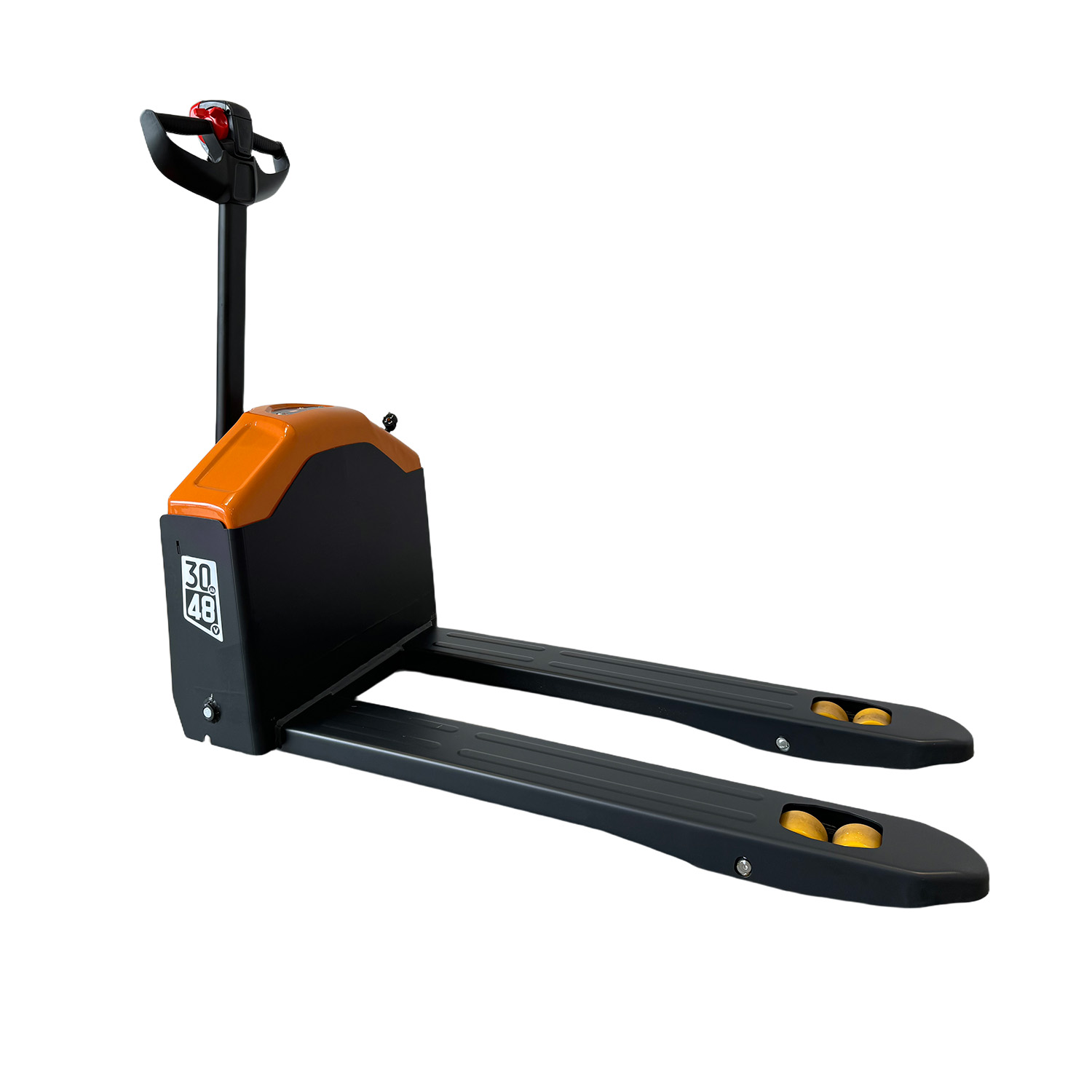
When facility demands outgrow manual capabilities, upgrading to electric pallet trucks fundamentally changes how material moves through your building. It shifts the burden of labor from the operator's muscles to an electric motor.
Motorized drive and lift functions drastically cut cycle times. Operators simply press a button to lift the load and engage a throttle to move it. This eliminates the time spent pumping a handle and fighting static friction. The consistent lifting power stabilizes operations during peak volume periods. Every pallet moves at the same predictable speed, regardless of how many hours the operator has been working.
Modern units utilize AC drive motors rather than older DC technology. AC motors lack wearable carbon brushes, reducing maintenance intervals. They also provide superior torque control at low speeds. This allows operators to creep into tight pallet racks with millimeter precision.
Enhanced load control represents a major operational upgrade. Motorized units feature smooth acceleration curves programmed into the motor controller. This prevents the sudden jerking motions that often cause unstable products to topple off pallets. Auto-braking systems engage the moment the operator releases the throttle. The electromagnetic brake clamps down on the motor shaft, stopping the machine safely and predictably. This precision is invaluable when navigating tight staging lanes or loading trailers.
Navigating inclines becomes a safe, routine task. Pushing a fully loaded manual jack up a dock plate into a trailer is physically exhausting and often dangerous. Motorized units power up slight inclines and ramps effortlessly. They maintain traction and speed, ensuring that loading and unloading processes remain fluid even when trailer heights do not perfectly match the dock door.
The power sources driving these machines have evolved dramatically. Legacy lead-acid batteries dominated the industry for decades, but they brought significant maintenance burdens. Lead-acid systems require regular watering to maintain electrolyte levels. They need weekly equalization charges to balance cell voltages. Furthermore, they demand long cooling periods after charging, often requiring facilities to maintain multiple batteries per machine for multi-shift operations.
Modern lithium battery pallet jacks have eliminated these bottlenecks. Lithium-ion technology requires zero maintenance. There is no watering, no off-gassing, and no need for dedicated, ventilated battery rooms. The internal Battery Management System (BMS) automatically balances cell voltages and protects against overcharging.
Opportunity charging changes the workflow entirely. Operators can plug the equipment into a standard wall outlet during a 15-minute coffee break or a 30-minute lunch. The battery accepts high charge rates without suffering degradation or memory effects. This allows a single battery to power a machine through multiple shifts. Additionally, lithium batteries are significantly lighter and smaller than their lead-acid counterparts. This weight reduction improves overall maneuverability and allows engineers to design more compact chassis footprints.
Choosing the right equipment requires a side-by-side comparison across several operational dimensions. You must evaluate your specific facility layout, the types of loads you handle, and your internal safety protocols.
The "40-foot rule" serves as a reliable baseline for material handling efficiency. If your average pallet movement exceeds 40 feet, manual equipment will drag down your throughput. The walking time and physical exertion simply take too long. Motorized units travel at faster, consistent speeds, making them mandatory for long runs across large distribution centers.
Turning radius requirements dictate maneuverability. Manual units pivot almost perfectly on their own axis. They require very little space to turn around inside a trailer or a narrow aisle. Older motorized models featured bulky battery compartments that extended the head length, making tight turns difficult. However, modern compact motorized models have closed this gap significantly, offering turning radii that rival manual units.
Floor conditions impact equipment choice. Manual jacks typically use nylon or polyurethane wheels. They handle rough concrete and minor debris reasonably well. Motorized units contain sensitive electronics, wiring harnesses, and drive motors. They require relatively smooth, well-maintained floors. Deep potholes, severe expansion joints, or heavy debris can damage the undercarriage or cause premature wear on the drive wheel. If your facility has wide expansion joints, the small load wheels on motorized units will suffer severe impact damage over time.
Fork dimensions and profiles determine what you can lift. Manual jacks offer incredible versatility. Their low-profile forks easily slip into standard GMA pallets, Euro pallets, and even custom skids with low clearances. The chamfered fork tips and entry rollers help the forks glide over bottom boards without splintering the wood.
Chassis bulk can sometimes limit motorized units. The housing that contains the drive motor and battery sits behind the forks. In extremely tight staging lanes, this housing might bump into adjacent pallets before the forks are fully inserted. You must ensure the fork length and overall chassis dimensions align with your specific racking and staging setups. Measure your right-angle stack requirements before committing to a specific chassis length.
Environmental ratings matter for specialized facilities. If you operate a food processing plant that requires high-pressure chemical washdowns, manual stainless steel units are easily sanitized. If you deploy motorized units in these areas, they must carry specific IP (Ingress Protection) ratings. The electronics must be sealed against water and dust intrusion to prevent catastrophic failures.
Workplace safety extends beyond accident prevention; it includes long-term ergonomic health. Initiating movement with a 4,000-pound load on a manual jack requires substantial push/pull force. Operators often use their entire body weight to break the static friction. Doing this dozens of times a day leads to fatigue and potential injury.
OSHA closely monitors musculoskeletal disorders (MSDs) in warehouse environments. Repetitive strain injuries from heavy pushing and pulling are a leading cause of lost-time incidents. Upgrading to motorized equipment virtually eliminates this specific strain. The motor handles the heavy lifting and the forward propulsion.
Motorized units also introduce active safety features. Belly switches are standard on powered handles. If an operator is backed into a wall or rack, the switch hits their body and instantly reverses the truck's direction, preventing crush injuries. Speed limiters automatically reduce travel speed when the handle is in a near-vertical position, allowing for safe, slow-speed maneuvering in tight confines.
Regulatory compliance differs significantly between the two categories. Under OSHA standard 1910.178, motorized pallet jacks are classified as powered industrial trucks. Operators cannot legally use them without formal certification. This involves classroom instruction, practical hands-on training, and a site-specific evaluation.
Manual units require minimal, on-the-job training. You show the operator how to use the pump, how to release the pressure, and basic safety rules regarding foot placement. They can be working independently within minutes.
You must factor training time into your operational planning. Maintaining a fleet of motorized units means you must maintain a roster of certified operators. You must track certification expirations, conduct refresher courses every three years, and retrain operators if they are involved in near-miss incidents.
Evaluation Dimension | Manual Equipment | Motorized Equipment |
|---|---|---|
Optimal Travel Distance | Under 40 feet | 40 to 100+ feet |
Operator Strain | High (relies on physical push/pull) | Low (motorized drive and lift) |
Training Requirements | Basic safety instruction | Formal OSHA certification required |
Pallet Compatibility | High (fits almost all standard/custom skids) | Moderate (motor housing may limit tight access) |
Braking System | Manual resistance | Automatic electromagnetic braking |
Floor Condition Tolerance | High (handles rough concrete well) | Low (requires smooth, debris-free floors) |
Transitioning from manual to motorized equipment requires careful facility planning. Simply purchasing new units and dropping them onto the dock will likely cause immediate operational friction. You must prepare your infrastructure and your maintenance teams.
Motorized equipment requires power. You must assess your electrical infrastructure before taking delivery. While modern lithium units often plug into standard 110V wall outlets, charging ten units simultaneously on the same circuit will trip breakers. You need to establish dedicated charging stations with adequate electrical capacity.
Follow these steps to prepare your facility:
Measure all dock plate breakover angles to ensure adequate undercarriage clearance.
Audit electrical panels to confirm sufficient amperage for dedicated charging circuits.
Map out charging zones away from high-traffic forklift lanes and pedestrian walkways.
Inspect concrete floors for severe expansion joint spalling that could damage drive wheels.
Verify that trailer floor conditions at your receiving docks can support the heavier weight of motorized units.
Ramp grades and dock plate transitions require close inspection. Motorized units have lower ground clearance beneath the battery compartment compared to the open space under a manual jack handle. If your dock levelers create a steep breakover angle into the trailer, motorized units can high-center and get stuck. Measure your steepest inclines and verify the gradeability and ground clearance specs of the equipment before purchasing.
A broken manual jack is an inconvenience. You push it to the side and grab another one. A dead motorized unit can halt a loading operation entirely. If a drive motor fails or a wiring harness shorts out, the unit becomes an immovable heavy obstacle on the dock.
Mitigate these risks through strict preventative maintenance schedules. Do not wait for equipment to break. Schedule regular inspections of drive wheels, contactors, and hydraulic seals. Standardize your battery types across the fleet so chargers and procedures remain uniform. Always maintain a small reserve of manual units. These act as critical redundancies. If the power goes out or a motorized unit fails during a critical shipment, the manual units will keep the freight moving.
Maintenance Component | Manual Task | Motorized Task | Recommended Frequency |
|---|---|---|---|
Load Wheels | Check for flat spots and debris | Check for flat spots and bearing wear | Weekly |
Hydraulics | Check fluid level and pump seals | Check lift cylinder and hose fittings | Monthly |
Drive System | Grease pivot points | Inspect drive tire wear and motor cables | Monthly |
Electrical | N/A | Test belly switch, horn, and contactors | Daily (Pre-shift) |
Procuring new material handling equipment involves more than just reading specification sheets. You are entering a long-term relationship with an equipment dealer and a manufacturer. The support you receive after the sale is just as important as the hardware itself.
When evaluating electric pallet trucks for sale, scrutinize the vendor's service capabilities. Look closely at the warranty terms. Does it cover parts and labor, or just parts? What is the warranty on the lithium battery? Demand clear Service Level Agreements (SLAs) regarding technician response times. If a unit goes down, you need to know a technician will be on-site within a guaranteed window.
Local parts availability is crucial. Ask the dealer where they stock their replacement parts. If every minor repair requires shipping parts from overseas, your downtime will skyrocket. A strong local dealer will keep common wear items like load wheels, drive tires, and contactors stocked in their local vans or nearby warehouses.
Never buy in bulk without a demo period. Request a site survey. Have the dealer bring a demo unit to your facility. Run it through your tightest aisles. Drive it over your worst dock plates. Have your operators use it for a full shift. Operator feedback during a demo period often reveals ergonomic or functional issues that specification sheets hide.
Consider how new equipment will integrate with your existing workflows. If you currently use a mix of different brands, introducing another manufacturer complicates your maintenance program. Standardization brings massive benefits. Using the same Original Equipment Manufacturer (OEM) across your fleet streamlines your parts inventory. Your maintenance team only needs to learn one diagnostic software system. Your operators develop muscle memory for one specific control handle design.
Plan for future scalability. If your facility volume grows by twenty percent next year, can your chosen equipment handle the increased duty cycles? Discuss fleet management telematics with your vendor. Many modern units offer access control via PIN codes or RFID badges, ensuring only certified operators can turn the machine on. These systems also track impact events and usage hours, providing valuable data for future procurement decisions.
The choice between manual and motorized material handling equipment defines your operational efficiency. Manual units remain the undisputed standard for low-volume, short-distance, and highly specialized environmental applications. They are reliable, instantly available, and require zero infrastructure. However, as facility footprints expand and throughput demands increase, the physical limitations of manual labor become severe bottlenecks. Motorized solutions are mandatory for scaling high-throughput, long-distance, and heavy-load operations safely.
Before requesting quotes, audit your current travel distances. Measure the exact paths your operators walk. Weigh your average and maximum pallet loads to understand the physical strain on your team. Calculate the potential labor hours saved by reducing cycle times with motorized equipment.
Take the following steps to finalize your equipment strategy:
Conduct a comprehensive facility layout audit to identify tight bottlenecks and measure dock plate inclines.
Assess your current electrical infrastructure to confirm you have adequate capacity and locations for charging stations.
Survey your operators to identify areas where physical fatigue slows down end-of-shift productivity.
Contact a certified local dealer to schedule an on-site evaluation and request a demo unit for your specific application.
A: Yes. Under OSHA standard 1910.178, motorized material handling equipment is classified as powered industrial trucks. Operators must complete formal classroom instruction, practical hands-on training, and a site-specific performance evaluation before legally operating the equipment.
A: Industry best practices recommend limiting manual travel to distances under 40 feet. Moving heavy loads beyond this threshold significantly decreases operational throughput and increases operator fatigue. For longer runs, motorized equipment is highly recommended.
A: A fully charged lithium unit typically lasts through a standard 8-hour shift under normal duty cycles. Because they support opportunity charging, plugging them in during 15-minute breaks or lunches can extend their operational time indefinitely without degrading the battery.
A: Most standard motorized units are designed for smooth, indoor concrete floors. Using them outdoors on rough asphalt or gravel can damage the polyurethane drive wheels and internal electronics. Specialized outdoor models with pneumatic tires and higher ground clearance are required for rough terrain.
A: Manual units generally last 5 to 7 years with basic maintenance, though harsh environments can shorten this. Motorized units typically last 7 to 10 years, provided they undergo regular preventative maintenance and the facility floors are kept in good condition.
A: Manual models have very low maintenance requirements, usually limited to replacing load wheels and hydraulic fluid. Motorized models have higher ongoing maintenance demands, including drive motor servicing, wiring inspections, and software diagnostics, requiring trained technicians.
A: Yes. Manual units generally feature lower fork profiles and lack the bulky rear motor housing found on powered units. This allows them to easily slide into custom skids, tight clearance pallets, and non-standard packaging that motorized units might struggle to access.