Views: 0 Author: Site Editor Publish Time: 2026-10-16 Origin: Site
Material handling bottlenecks directly impact warehouse profitability. Over-speccing equipment drains capital without delivering proportional returns. Under-speccing leads to chronic downtime and accelerated wear. Procurement and operations teams constantly struggle to balance upfront acquisition expenses with long-term reliability. Upgrading from manual fleets to motorized units introduces complex financial variables that go far beyond the initial purchase order. Understanding the true financial impact of pallet trucks requires a comprehensive look at maintenance schedules, operator ergonomics, and facility infrastructure. This guide breaks down the operational expenses and performance metrics of material handling equipment. We evaluate everything from entry-level manual jacks to heavy-duty electric models. You need a strict evaluation framework to align equipment specifications with daily operational realities. We provide exactly that, drawing from real-world warehouse floor experience.
Manual models offer the lowest barrier to entry but severely limit throughput and increase ergonomic risk in high-volume environments.
Entry-level electric units bridge the gap between manual jacks and full-size forklifts, while advanced ride-on models require a significantly larger capital commitment.
Lifetime operating expenses extend far beyond the initial quote; battery replacement, routine maintenance, downtime, and vendor support account for a massive portion of a unit's lifetime financial impact.
Established and premium brands command higher upfront investments but often offset expenses through extended warranties and reliable parts availability.
Upgrading drive components on existing manual trucks can sometimes yield substantial savings compared to purchasing net-new motorized units, though this introduces integration trade-offs.
Manual units represent the foundation of floor-level material handling. These machines rely entirely on human kinetic energy for both traction and hydraulic lifting. The primary target applications include low-volume environments, short-distance transport, and localized retail staging where space is exceptionally tight. Because they lack electronic components, their initial acquisition expense remains the lowest in the material handling spectrum. You can deploy dozens of these units for the price of a single motorized model.
Primary cost drivers for manual models revolve around physical construction materials. Fork dimensions, stated load capacity, steel gauge thickness, and wheel material dictate the overall quality. Polyurethane wheels offer quiet operation and floor protection. Nylon wheels provide lower rolling resistance for heavy loads but generate excessive noise on concrete floors. The main limitation of manual equipment is operator fatigue. Pushing a fully loaded manual jack requires immense initial force to overcome resting inertia. They become highly inefficient and physically hazardous when operators must navigate ramps, dock plates, or travel distances exceeding fifty feet on a regular basis. Hydraulic pump seals also wear out over time, requiring periodic rebuilds to maintain lifting capability.
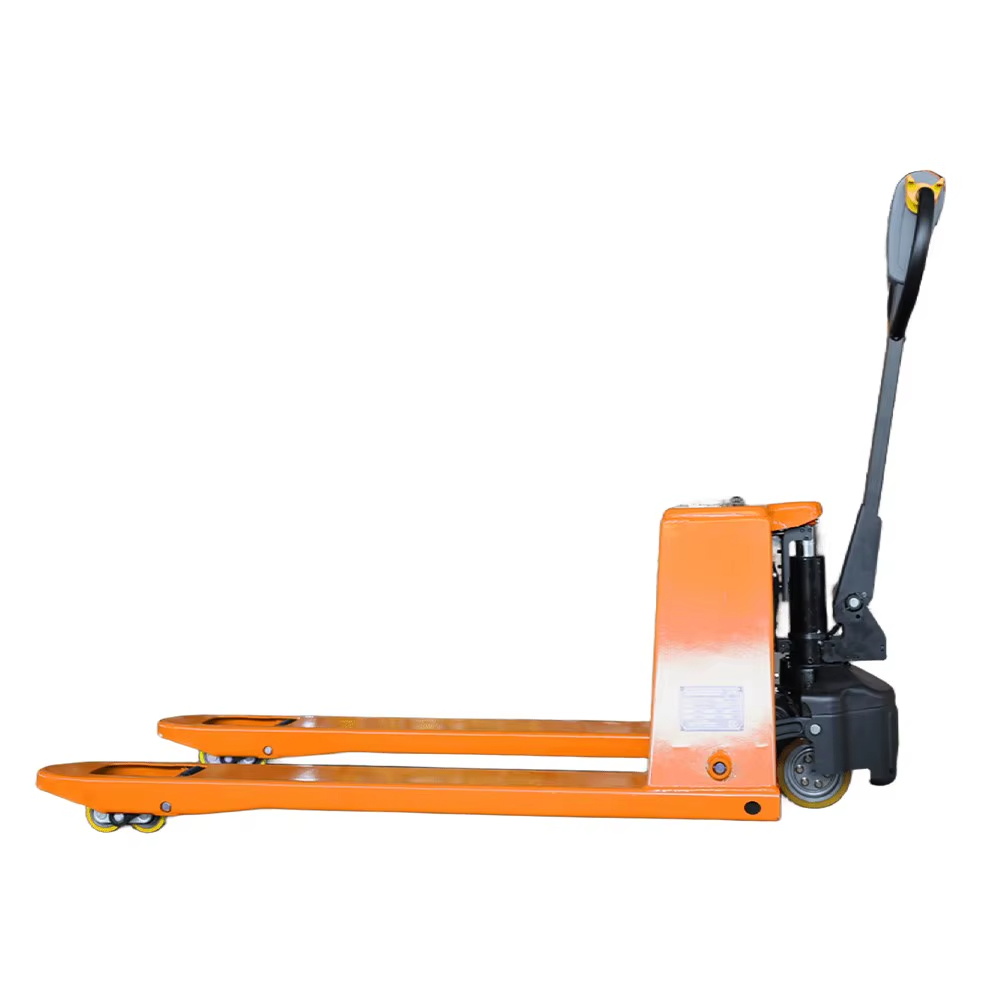
When manual operations reach their physical limits, facilities typically transition to an Electric Pallet Truck. These units are engineered for medium-duty warehousing, narrow aisle navigation, and delivery lift-gate operations. They eliminate the physical strain of pushing and pulling heavy loads. They utilize electric motors to handle traction and, in fully electric models, the lifting mechanism as well. This transition fundamentally changes how fast a single operator can move inventory across a facility.
The financial variables in this category depend heavily on battery chemistry and operational configuration. Semi-electric models feature a motorized drive wheel but retain a manual hydraulic pump for lifting. Fully electric models automate both functions, increasing the upfront investment but maximizing ergonomic benefits. The core value proposition here is a drastic reduction in operator musculoskeletal strain with only a minimal increase in the equipment's physical footprint. This allows facilities to increase pallets-moved-per-hour without redesigning their aisle layouts. You also see a sharp drop in fatigue-related errors near the end of a long shift.
High-throughput distribution centers, cross-docking facilities, and operations requiring long-distance warehouse runs demand robust solutions. A Heavy Duty Electric Pallet Truck is built with reinforced steel chassis, high-torque AC drive motors, and larger battery compartments to sustain continuous multi-shift operations. Ride-on models feature fold-down platforms or enclosed operator compartments. This allows workers to travel at higher speeds safely across massive distribution centers.
Investments in this tier are driven by advanced features designed to maximize velocity. Power steering reduces operator fatigue during continuous maneuvering. Advanced safety sensors, regenerative braking systems, and integration with warehouse fleet management software add to the initial expense. However, they provide critical operational data. The value proposition is clear. These units serve as a direct, highly efficient alternative to traditional sit-down forklifts for floor-level tasks. They move inventory rapidly across vast facility footprints without the overhead clearance requirements of a mast forklift.
Procurement teams often face a stark choice between premium, established brands and budget-friendly imports. Industry benchmarks consistently show that premium brands command higher initial investments. This premium pays for proven engineering reliability, rigorous quality control, and robust dealer networks. A strong dealer network guarantees parts availability decades after the initial purchase. When a proprietary controller board fails, you need a replacement immediately, not three months later on a cargo ship.
Beyond the sticker price, buyers must budget for hidden acquisition expenses. Freight shipping for heavy machinery adds considerable weight to the final invoice. Depending on the region, taxes, import duties, and dealer preparation fees must be factored into the capital expenditure request. Failing to account for these secondary expenses often leads to budget overruns before the equipment even hits the facility floor. You must demand fully landed quotes from vendors to avoid surprise logistics fees.
Selecting the correct capacity requires analyzing both static weights and dynamic forces. A standard manual jack might boast a high static weight limit, but subjecting it to continuous, heavy-duty operational demands will rapidly degrade its components. When upgrading, evaluating the continuous operational demands of a 2 Ton Electric Pallet Jack ensures the equipment can handle the actual throughput without straining the drive motor. You have to look at what the machine does during peak season, not just an average Tuesday.
The risk of under-speccing equipment is severe. Consistently pushing a machine to its absolute maximum capacity causes accelerated wear on load wheels and premature hydraulic pump failure. Dynamic loads multiply the force exerted on the chassis. Bouncing over a dock plate with a heavy pallet is a prime example. Chronic overloading not only leads to catastrophic equipment failure but also routinely voids manufacturer warranties. This leaves the facility responsible for all repair expenses. Always spec a machine with a capacity buffer of at least twenty percent above your heaviest typical load.
Equipment specifications must align perfectly with the physical realities of the building. Spatial limitations dictate the maximum allowable dimensions of the machinery. Procurement teams must calculate required aisle widths and right-angle stacking turning radii before finalizing a purchase. Larger motorized units, especially ride-on models, require significantly more room to maneuver safely compared to compact manual jacks. You cannot force a massive ride-on unit into a tight retail backroom.
Floor conditions play a massive role in equipment longevity. Uneven surfaces, steep dock plates, and floor debris aggressively degrade drive wheels. Shrink wrap and pallet splinters frequently get sucked into wheel axles, burning out drive motors if not cleared. If a facility has rough concrete or frequent transitions, specialized wheel compounds become necessary. Operating in cold storage, wash-down facilities, or corrosive chemical plants requires galvanized or stainless steel models. These specialized coatings carry a significant price premium but are absolutely essential to prevent rapid rust and structural degradation.
Wheel Material | Best Application Environment | Primary Drawbacks |
|---|---|---|
Polyurethane | Smooth concrete, retail floors, clean warehouses | Chunks easily on rough dock plates or debris |
Nylon | Heavy loads, cold storage, wet environments | Extremely loud on concrete, less traction |
Rubber | Rough outdoor surfaces, uneven asphalt | High rolling resistance, wears out quickly |
Steel | Extreme heavy manufacturing, metal chips on floor | Destroys concrete floors over time, zero shock absorption |
The power source dictates the maintenance schedule, shift capabilities, and overall lifespan of motorized units. The industry is currently split between traditional lead-acid technology and modern lithium-ion solutions. Each presents distinct financial and operational profiles. Choosing the wrong battery chemistry will cripple your shift transitions and inflate your maintenance labor hours.
Lithium-ion batteries require a higher upfront investment but fundamentally change warehouse workflows. They enable opportunity charging. Operators can plug the unit in during fifteen-minute breaks or lunch hours without damaging the battery cells. They require zero watering or equalization maintenance and generally offer up to three times the lifespan of traditional batteries. Conversely, flooded lead-acid batteries present a lower initial procurement barrier. However, they demand strict charging protocols. You must follow the eight hours of use, eight hours of charging, and eight hours of cooling rule. Flooded variants require regular watering to prevent cell damage. They also add significant physical weight to the unit, which can drain the battery faster during travel.
Feature | Lithium-ion | Lead-Acid (Flooded/AGM) |
|---|---|---|
Initial Investment | Higher upfront capital required | Lower initial procurement barrier |
Maintenance | Zero maintenance required | Requires regular watering and equalization |
Charging Protocol | Supports opportunity charging anytime | Strict 8-8-8 cycle (Use, Charge, Cool) |
Lifespan | Extended lifespan (up to 3x longer) | Shorter lifespan, degrades if misused |
Weight | Lightweight, improves energy efficiency | Heavy, acts as counterweight but drains power |
Investing in motorized equipment is often driven by risk management and occupational safety goals. Manual material handling is a leading cause of workplace injuries. Motorized traction directly correlates to a reduction in OSHA recordable incidents related to push and pull musculoskeletal strains. By eliminating the initial force required to move a heavy pallet, facilities protect their workforce and reduce workers' compensation claims. A healthy operator moves more freight.
Safety features on motorized units require careful evaluation. Emergency belly buttons are standard and non-negotiable for safety. These switches are located on the tiller head and instantly reverse the machine if it pins an operator against a rack. Anti-rollback brakes ensure the unit remains stationary on inclines or dock ramps. Advanced models feature speed-governed cornering. This automatically reduces travel speed when the tiller is turned sharply, preventing load spills and tip-overs during aggressive maneuvering. You also need to ensure operators wear proper steel-toe footwear, as motorized units carry enough mass to crush a foot instantly.
The initial purchase order represents only a fraction of the total financial commitment. Consumables and wear parts generate continuous expenses throughout the machine's life. Facilities must budget for the routine replacement of load wheels, caster wheels, and hydraulic seals. Polyurethane wheels driven over rough dock plates will chunk and tear. You must replace them frequently to maintain smooth operation and protect the drive motor from excessive vibration. Ignoring a flat-spotted wheel will eventually shake the internal electronics to pieces.
Downtime impact is the most critical hidden expense. Calculating the financial impact of a grounded truck during peak shifts often reveals that cheap equipment costs more in the long run. When a unit fails, operators either resort to manual labor or wait for a replacement. This slows throughput drastically. Maintaining redundant units ensures continuous operation but ties up capital in unused assets. High-quality equipment minimizes unplanned downtime, keeping the supply chain moving smoothly. You need machines that stay on the floor, not in the maintenance bay.
Where you buy the equipment is just as important as what you buy. Purchasing through established dealer networks provides a distinct financial advantage. Local service technicians can arrive on-site rapidly with the correct diagnostic tools and replacement parts. Direct-to-consumer budget imports often lack this infrastructure. This leaves facilities entirely responsible for diagnosing electrical faults and sourcing proprietary components from overseas. Waiting three weeks for a simple contactor switch is unacceptable in a busy warehouse.
Warranty coverage requires intense scrutiny. Procurement teams must analyze the fine print differentiating structural, drivetrain, and battery warranties. A long structural warranty means little if the drive motor is only covered for six months. Parts availability dictates long-term viability. If a manufacturer discontinues a proprietary controller board, the entire machine becomes obsolete the moment that board fails. Always ask vendors for their guaranteed parts availability window before signing a purchase order.
For operations looking to motorize without purchasing entirely new fleets, retrofit solutions offer an alternative path. Drive component upgrades involve removing the manual steering wheels and hydraulic pump handle from an existing manual jack. You then bolt on an aftermarket motorized drive wheel and battery pack. This turns a manual unit into a semi-electric hybrid.
This approach requires weighing conceptual trade-offs. The immediate capital savings are substantial compared to buying net-new motorized units. However, this introduces warranty limitations. Modifying the original equipment immediately voids manufacturer support. The structural integrity of older manual frames may not withstand the instant torque generated by an electric drive wheel. Welds can crack under the new stress. Finally, retrofits typically only motorize the travel function. The operator must still manually pump the hydraulics to lift the load, leaving a portion of the ergonomic strain unresolved.
Introducing motorized equipment into a previously manual environment carries immediate physical risks. The primary danger involves the mishandling of high-torque machinery. Electric drive wheels deliver instant power. An untrained operator accustomed to throwing their body weight into a manual jack will likely pin the throttle on an electric unit. This causes it to jerk violently. This leads to dropped loads, damaged product, and potential facility collisions. Racking impacts are expensive to repair.
Mitigating this risk requires structured onboarding. Implementing mandatory, documented training programs ensures every operator understands the throttle response and braking distances. Many modern units feature PIN-code access systems that allow managers to restrict high-speed settings. Locking new operators into a low-speed turtle mode during their first few weeks prevents accidents. They need time to build muscle memory for the electronic controls before handling the machine at full speed.
Transitioning to an electric fleet fundamentally changes a facility's electrical demands. The primary risk is overloaded facility electrical panels or inefficient charging workflows that leave equipment dead mid-shift. Plugging multiple heavy-duty chargers into a standard wall circuit will trip breakers and halt operations. You cannot treat industrial chargers like standard office electronics.
Mitigation starts with pre-procurement electrical audits. Facilities must verify that their infrastructure can handle the combined amperage draw of the entire fleet charging simultaneously. Deploying decentralized charging stations near operator break areas facilitates opportunity charging for lithium-ion units. Placing chargers strategically eliminates the dead travel time required to drive equipment to a centralized battery room. This keeps the machines active on the floor where they generate value.
To finalize the procurement process and ensure your facility selects the exact right equipment for your operational demands, execute the following steps immediately:
Audit current maintenance logs to identify failure trends and calculate the true financial impact of existing equipment downtime.
Measure average daily travel distances and weigh the heaviest typical loads to establish strict baseline capacity specifications.
Assess facility floor conditions and dock plate transitions to determine the necessary wheel compounds and chassis clearance.
Conduct an electrical infrastructure audit to verify charging capacity and panel amperage before committing to a specific battery technology.
Request on-site demo units for the top two shortlisted models to evaluate real-world operator adoption and maneuverability in your specific aisles.
A: Battery lifespan depends on the chemistry and maintenance. Lithium-ion batteries typically last between 3,000 to 5,000 charging cycles with zero maintenance. Traditional lead-acid batteries generally last 1,500 to 2,000 cycles, provided operators strictly follow charging protocols and perform regular watering. Neglecting lead-acid maintenance drastically reduces its operational life.
A: A semi-electric model features a motorized drive wheel for forward and reverse travel, but relies on a manual hydraulic pump handle to lift the forks. A fully electric model automates both functions, using electric motors for both traction and lifting, completely eliminating physical operator strain.
A: Yes, in high-throughput environments. Premium brands utilize higher-grade steel, more durable contactors, and advanced AC motors. More importantly, they provide extensive dealer networks, ensuring rapid on-site service and guaranteed replacement parts availability, which minimizes costly operational downtime over the machine's lifespan.
A: While a traditional sit-down forklift license is not always legally required for floor-level pedestrian trucks, OSHA and local safety regulations mandate that operators receive formal, documented training and certification specific to the motorized equipment they will be operating.
A: Manual units require minimal but consistent maintenance. Annual expectations include greasing zerk fittings, checking hydraulic fluid levels, inspecting the pump seals for leaks, and replacing worn polyurethane load wheels. Neglecting wheel replacement forces the operator to exert significantly more effort to move loads.
A: A unit specifically rated for 2 tons can lift that weight statically. However, dynamic forces multiply the stress on the frame when moving that load over uneven floors or dock plates. If you consistently move 2-ton loads, upgrading to a higher-capacity heavy-duty model prevents premature structural failure.