Views: 0 Author: Site Editor Publish Time: 2026-10-23 Origin: Site
Mismatched material handling equipment causes severe operational friction. You see this daily when the wrong forklift configuration damages racking systems. It bottlenecks throughput during peak hours. It wastes valuable vertical space. Facility managers constantly face a core business problem. They must maximize warehouse storage density using narrow aisles. Simultaneously, they must maintain absolute stability for heavy, high-reach loads. You cannot compromise on either front. The solution starts with the fundamental choice between three-wheel and four-wheel configurations. This single decision drives your facility layout. It dictates operational efficiency. It impacts your long-term equipment strategy. Understanding the mechanical differences helps you optimize your fleet. We will break down the physics, performance metrics, and ideal applications for both designs. You will learn how to match the right chassis to your specific operational constraints.
Maneuverability vs. Stability: Three-wheel models dominate in tight, indoor spaces with superior turning radii, while four-wheel models provide the lateral stability required for heavy loads and uneven terrain.
Capacity Ceilings & Cost: Three-wheel variants typically max out around 4,000 to 5,000 lbs and generally offer a lower upfront acquisition cost; exceeding this capacity requires a four-wheel chassis.
Environmental Constraints & Tires: Four-wheel forklifts are better suited for hybrid indoor/outdoor applications (utilizing pneumatic tires), whereas three-wheelers rely on cushion tires strictly for smooth, indoor surfaces.
Power Modernization: The shift toward the lithium battery counterbalance forklift is equalizing performance metrics, offering longer runtimes and zero-maintenance power across both wheel configurations.
Closing the Gap: Modern four-wheel electric models featuring dual-drive motors are drastically reducing their turning radius, making them increasingly competitive in tighter spaces.
Material handling success relies on strict criteria. You must move maximum tonnage. You must utilize a minimal operational footprint. You must maintain zero safety incidents. Achieving this requires the right equipment geometry. The foundational engineering of your lift trucks dictates how they perform under stress. You cannot force a machine to perform outside its physical design limits without risking product damage or operator injury.
Every lift truck operates on basic fulcrum physics. The front wheels act as the pivot point. The load sits in front of this pivot. The machine's weight sits behind it. In a three-wheel design, the center of gravity shifts within a stability triangle. The three points connect the two front wheels and the single rear steering pivot. Four-wheel models utilize a stability pyramid. The rear axle pivots on a center pin, creating a broader base for lateral support. The heavy battery and the cast-iron rear weight act together as the primary counterweight. This internal mass prevents the truck from tipping forward when lifting heavy pallets. When evaluating counterbalanced forklifts, you must understand how this weight distribution affects overall capacity.
Capacity is never a static number. It changes based on the load center. A standard 48-inch pallet has a 24-inch load center. If you pick up a 60-inch load, the load center shifts forward to 30 inches. This shift drastically reduces the machine's safe lifting capacity. Furthermore, as you lift a heavy load into high racking, the mast naturally bends slightly forward. This is called mast deflection. It pushes the center of gravity even further away from the fulcrum. Four-wheel models generally handle severe mast deflection better than three-wheel models due to their wider rear stance. You must account for these dynamic shifts when planning your high-bay storage strategy.
The steering axle design dictates the machine's pivot point. This geometry changes how the truck navigates corners. You must account for the rear tail swing during tight maneuvers. While both styles use internal counterweights, their distinct geometries dictate entirely different use cases. They require specific tire compatibilities. They demand different operational footprints. You cannot swap them interchangeably across all warehouse zones. A setup designed for narrow aisles will struggle on uneven loading docks. A heavy-duty yard truck will waste space inside a dense storage facility.
High-density indoor warehousing requires specialized equipment. Space is a premium commodity. You need machines that turn within their own footprint. The three-wheel configuration stands as the industry standard for these environments. It allows facility planners to compress aisle widths and maximize pallet positions.
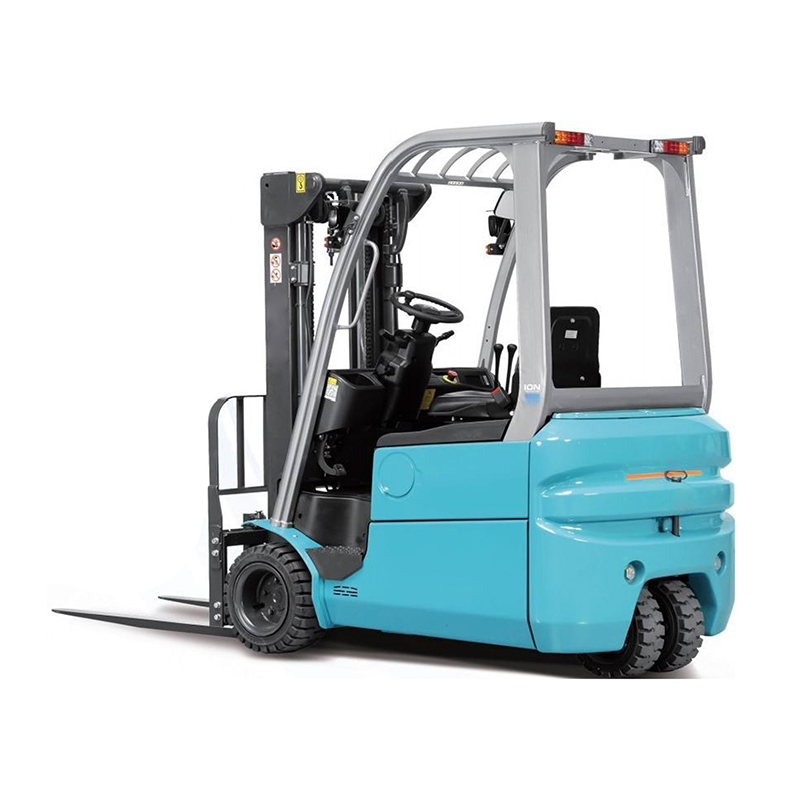
The primary advantage is the zero-turn capability. The rear steering wheel pivots a full 90 degrees. This allows the truck to spin on its axis. You gain massive aisle-width savings. Facilities often reduce their aisle widths to 10 or 11 feet, depending on the load length. This density increases overall storage capacity. A 3 Wheel Electric Counterbalance Forklift generally requires a smaller physical footprint. The compact chassis uses less steel. You get a highly agile machine optimized for rapid indoor transit. Operators can navigate congested staging areas with minimal risk of rack impacts.
Agility comes with specific physical limitations. You face strict load capacity limits. These models generally max out under 5,000 lbs. Pushing beyond this ceiling risks the stability triangle. They are also highly vulnerable to uneven surfaces. You cannot run them over rough dock plates safely. Outdoor debris poses a major hazard. They rely exclusively on smooth cushion tires. These tires offer zero shock absorption on rough terrain. Operating them outside damages the undercarriage, chunks the rubber tires, and risks operator safety.
You should deploy these units in highly controlled spaces. They excel in specific applications where floor conditions are pristine and space is tight.
E-commerce fulfillment centers utilizing narrow drive-in racking systems.
Cold storage facilities where square footage is highly restricted and expensive to maintain.
Tight-racking retail warehouses requiring rapid, continuous pallet movement.
Clean-room manufacturing floors featuring polished concrete surfaces.
Food and beverage staging areas with high pedestrian traffic and tight corners.
Heavy-duty applications demand a different approach. When load weights increase, you need a broader stance. The four-wheel configuration serves as the versatile workhorse for demanding industrial environments. It bridges the gap between indoor material handling and rugged outdoor yard work.
Four wheels provide enhanced lateral stability. The stability pyramid handles off-center loads much better than a triangle. You get significantly higher load capacities. Electric models range from 3,000 up to 12,000 lbs or more. They handle articulation over uneven surfaces with ease. You get superior gradeability on steep warehouse ramps. You can equip them with pneumatic or solid pneumatic tires. This allows safe operation on rough terrain, gravel yards, and degraded asphalt. A 4 Wheel Electric Forklift handles the harsh transitions from warehouse floors to trailer beds without compromising load security.
Historically, these trucks were clumsy in tight spaces. Modern engineering has changed this dynamic. Manufacturers now utilize advanced dual-drive motors on the front axle. These motors allow the front wheels to operate independently. When turning, the inside wheel spins in reverse while the outside wheel drives forward. This significantly reduces the turning radius. It closes the agility gap with three-wheel models. You get heavy-duty stability with surprisingly sharp cornering capabilities. While they still cannot spin exactly on their own axis, they navigate 12-foot aisles with relative ease.
Standard forks are just the beginning. Many operations require specialized hydraulic attachments. Paper roll clamps, single-double pallet handlers, and push-pull mechanisms add significant weight to the front carriage. They also push the load center further away from the fulcrum. This causes severe capacity deration. Four-wheel models are built to handle this stress. Their broader rear stance resists the forward and lateral pull of heavy attachments. If your workflow relies on complex load manipulation, the four-wheel chassis provides the necessary safety margin.
These machines thrive where versatility is mandatory. Consider them for environments that mix indoor and outdoor tasks.
Heavy manufacturing plants moving raw steel, lumber, or large industrial components.
Cross-docking operations featuring steep dock levelers and uneven trailer beds.
Building materials yards requiring frequent indoor-to-outdoor transitions.
Beverage distribution centers handling double-pallet loads simultaneously.
Agricultural processing facilities with degraded concrete or packed dirt surfaces.
You must compare these two solutions across critical operational dimensions. Do not rely solely on spec sheets. Evaluate how the equipment interacts with your specific facility layout, floor conditions, and daily workflow.
Evaluation Feature | 3-Wheel Configuration | 4-Wheel Configuration |
|---|---|---|
Turning Radius | Zero-turn capability; highly compact. | Larger radius; requires wider clearance. |
Load Capacity | Typically capped at 4,000 - 5,000 lbs. | Ranges from 3,000 to 12,000+ lbs. |
Tire Compatibility | Cushion tires only (smooth surfaces). | Cushion, solid pneumatic, or pneumatic. |
Lateral Stability | Moderate; relies on stability triangle. | High; utilizes stability pyramid. |
Ideal Terrain | Polished concrete, indoor only. | Uneven floors, ramps, outdoor yards. |
Attachment Suitability | Low; severe deration with heavy attachments. | High; handles forward center of gravity shifts well. |
Dock Plate Transitions | Poor; risks undercarriage damage and load spills. | Excellent; articulates over steep dock levelers. |
Analyze the value of your warehouse space. Compare the real estate value against the equipment investment. Narrowing your aisles by two feet across a massive facility adds hundreds of pallet positions. You must calculate required aisle widths accurately. Use the Right Angle Stack (RAS) formula. The RAS equals the truck's basic turning radius, plus the load length, plus a 12-inch safety clearance. Three-wheel models consistently yield a lower RAS. This allows you to compress your racking strategy and maximize vertical storage. If you run a high-volume distribution center, those extra pallet positions directly increase your operational capacity.
Operator comfort directly impacts productivity. Ride quality matters during a grueling eight-hour shift. Three-wheel models transfer floor vibrations directly to the operator. The hard cushion tires offer no give. Every expansion joint sends a shockwave up the steering column. Four-wheel models generally absorb shock better. If equipped with pneumatic tires, they glide over expansion joints and dock plates. This reduces spinal compression and operator fatigue. A comfortable operator moves pallets faster, stays alert longer, and makes fewer destructive errors.
Modern power sources drastically impact the configuration decision. The shift away from legacy power systems changes how these trucks perform. It alters maintenance schedules and facility requirements. You no longer have to design your warehouse around a massive battery charging room.
Traditional lead-acid batteries require dedicated charging rooms. They need weekly watering. They require eight-hour cool-down periods. Lithium-ion technology eliminates these constraints. You completely remove battery watering maintenance. You reclaim the square footage previously used for battery storage and ventilation equipment. More importantly, lithium allows for opportunity charging. Operators plug the truck in during 15-minute coffee breaks or lunch shifts. A Lithium Battery Counterbalance Forklift runs continuously through multi-shift operations without battery swaps. This consistent power delivery keeps travel speeds and lift speeds at maximum capacity, regardless of the remaining charge.
Lithium batteries are significantly lighter than lead-acid units. This weight reduction presents an engineering challenge. The heavy lead-acid battery traditionally served as a major part of the truck's counterweight. Manufacturers must redesign the counterweight distribution when integrating lithium power. They add dense cast iron to the rear chassis to maintain the required stability. This redesign happens in both three-wheel and four-wheel models. It ensures the machine maintains its rated lifting capacity while benefiting from modern energy efficiency. The resulting trucks are often more compact, further improving their turning radius.
Acquiring new material handling equipment carries hidden pitfalls. You must audit your facility before signing purchase orders. Failing to verify operational constraints leads to expensive workflow bottlenecks. You cannot fix a bad equipment choice after it arrives on your dock.
Never procure a larger truck without verifying existing clearances. You must measure intersection widths. Two trucks must pass each other safely in main travel aisles. Check your racking tunnel heights and overhead door clearances. Verify the turning clearance at the end of every aisle. Purchasing a four-wheel model without confirming these dimensions forces costly facility redesigns. You might have to unbolt and re-profile warehouse racks. This halts operations and destroys your planned efficiency gains.
Different wheel configurations require different driving techniques. OSHA compliance mandates specific training for distinct equipment classes. A three-wheel truck corners aggressively. An untrained operator taking a corner too fast risks a lateral tip-over. The stability triangle is unforgiving at high speeds. Four-wheel trucks require familiarization with dual-drive steering feedback and wider tail swings. You must schedule dedicated safety training when transitioning operators between these two chassis types. Do not assume an operator skilled on a four-wheel truck can immediately master a three-wheel zero-turn model.
Look beyond the initial acquisition. Build a checklist to evaluate long-term operational factors. Track your maintenance intervals. Lithium models require less electrical maintenance, but you must still grease the mast, inspect the lift chains, and check the hydraulics. Analyze your tire replacement frequency. Cushion tires wear down quickly on rough concrete, leading to a bumpy ride and reduced clearance. Pneumatic tires risk punctures in debris-heavy yards. Calculate your energy consumption based on your local utility rates and charger amp draw. Map these variables to understand the true lifecycle impact of your equipment choice.
Conduct a professional site survey to measure all aisle widths, intersection clearances, and overhead obstructions.
Request a formal Right Angle Stack (RAS) calculation from your equipment dealer based on your longest pallet size and heaviest load.
Schedule an on-site demo to test operator comfort, visibility, and turning capabilities in your tightest warehouse zones.
Audit your floor conditions, including dock plates and expansion joints, to determine if cushion or pneumatic tires are required.
Review your attachment requirements to calculate potential capacity deration before finalizing the chassis size.
A: The primary difference lies in the steering mechanism and stability geometry. Three-wheel models use a single rear pivot point, creating a stability triangle ideal for tight turns. Four-wheel models use a traditional rear axle, forming a stability pyramid. This provides better lateral support for heavy loads.
A: They are generally restricted to smooth, indoor surfaces. They rely on hard cushion tires that offer no shock absorption. Operating them on rough outdoor terrain damages the undercarriage, risks load stability, and creates severe safety hazards for the operator.
A: Modern four-wheel models with dual-drive motors are highly agile. The front wheels spin independently to reduce the turning radius. However, they still cannot match the true zero-turn radius of a three-wheel model. They require wider aisles for safe operation.
A: Lithium batteries eliminate daily watering maintenance and cool-down periods. They allow for rapid opportunity charging during operator breaks. This keeps the truck running continuously across multiple shifts while delivering consistent power output, regardless of the remaining battery charge.
A: The standard industry ceiling for three-wheel configurations is typically around 4,000 to 5,000 lbs. Pushing beyond this weight limit compromises the stability triangle. For heavier loads, you must transition to a four-wheel chassis.
A: Yes. OSHA requires operators to be trained and evaluated on the specific type of truck they will use. The handling dynamics, cornering speeds, and tip-over risks differ significantly between the two configurations. Operators need equipment-specific familiarization.