Views: 0 Author: Site Editor Publish Time: 2026-10-03 Origin: Site
Selecting the wrong mast height for material handling equipment often creates immediate operational bottlenecks on the warehouse floor. You either fail to reach the top racking tier or end up colliding with facility doorways, HVAC ducts, and overhead sprinkler systems. Warehouse managers must balance the demand for vertical storage density against strict physical facility constraints. These include doorway heights, mezzanine load limits, and narrow aisle widths. You need to achieve this balance without over-investing in unnecessary mast complexity or heavy counterweights. This guide breaks down the technical specifications, facility requirements, and operational trade-offs between 1510 mm, 2410 mm, and 2910 mm lift heights. We will help you specify the exact equipment configuration for your daily workflow, ensuring your operators can move loads safely and efficiently.
Collapsed Height Dictates Mobility: The maximum lift height directly impacts the lowered mast height; ensure the chosen configuration clears your lowest facility doorway or overhead sprinkler system.
Capacity Derating is Inevitable: As lift height increases (particularly approaching 2910 mm), the safe working load capacity decreases. A 1.5-ton rated stacker will not lift its maximum capacity to its maximum height.
Application-Specific Matching: 1510 mm is optimal for truck loading and single-tier racks; 2410 mm serves standard two-tier systems; 2910 mm is required for specialized high-clearance vertical storage.
Mast Type Matters: The choice between simplex (single-stage) and duplex (two-stage) masts across the pallet stacker product range determines both visibility and maintenance overhead.
Pallet Compatibility is Non-Negotiable: Lift height is irrelevant if your stacker's legs cannot engage your pallets; closed-bottom pallets require specific straddle leg configurations.
Deploying an Electric Pallet Stacker requires precise facility mapping before you even look at equipment specifications. Material handling success relies on matching the machine's physical dimensions to your existing infrastructure. Measure the highest rack beam to determine the absolute maximum reach required. Next, measure the lowest doorway, overhead conveyor, and ceiling clearance to establish the maximum allowable collapsed mast height.
Identify the primary workflow for the equipment. Staging areas and direct truck loading operations demand different structural configurations than high-density vertical storage aisles. Establish the baseline requirement for a stacker versus a traditional counterbalance forklift. Stackers excel in narrow aisles and tight turning radii. They fit perfectly in facilities where space optimization takes priority over heavy-duty, outdoor material transport.
Measure the highest rack beam from the floor to the top edge of the load surface.
Record the height of the lowest doorway the equipment must pass through during a standard shift.
Identify overhead obstructions like HVAC ducts, lighting fixtures, and fire suppression pipes.
Calculate the maximum weight of your heaviest palletized load to determine capacity requirements.
The physics of mast staging dictate that higher lift capabilities require either a taller collapsed profile or a more complex multi-stage mast. Reaching 2910 mm typically requires a duplex (two-stage) mast. This folds down to a manageable height but adds mechanical complexity. A 1510 mm unit often utilizes a simplex (single-stage) mast. It offers a lower overall profile and fewer moving parts.
Evaluate the free lift requirement for your specific application. Free lift refers to the ability to raise the forks without extending the inner mast channels. This feature proves necessary when operating inside enclosed spaces like semi-trailers or shipping containers. If your workflow involves stacking pallets inside a trailer, a mast that extends upward immediately upon lifting will strike the trailer roof. This causes severe damage to both the equipment and the load.
Lift height specifications lose all relevance if the equipment cannot physically engage the loads. Pallet design dictates the fundamental chassis required. Open-bottom pallets work with fork-over stacker designs. The lifting forks lower directly over the support legs. Closed-bottom pallets possess bottom deck boards that block fork-over designs.
Handling closed-bottom pallets requires a straddle-leg configuration. The outrigger legs must physically straddle the outside edges of the pallet while the forks enter the pallet openings. Finalizing the required lift height must happen concurrently with selecting the correct leg configuration. This ensures load engagement at ground level.
When you lift heavy loads to heights of 2410 mm or 2910 mm, the point load on the front load wheels increases dramatically. Standard polyurethane wheels work well for smooth, indoor concrete floors, offering good traction and quiet operation. If your facility has rougher surfaces or metal dock plates, you might need harder nylon wheels to prevent rapid wear and tear. You must also verify the floor loading capacity of your mezzanine or upper-level storage areas. A fully loaded stacker exerts significant pressure through its small load wheels. If the floor cannot support the combined weight of the machine and the load, you risk structural damage to your facility.
The 1510 mm lift height configuration serves as the foundational tier for vertical material handling. This specification optimizes operations focused on single-tier racking, mezzanine floors with strict weight and height limits, and direct-to-truck loading. Facilities utilizing low-level storage racks benefit from this compact design. It provides just enough elevation to clear ground-level obstacles and stack loads two-high on the floor.
Operators gain high maneuverability in tight spaces due to the inherently lower center of gravity. The simplex mast utilized for 1510 mm heights offers exceptional forward visibility. Without a secondary mast channel or central cylinder blocking the view, operators can position forks with superior accuracy. This reduces product damage and improves cycle times during fast-paced staging operations.
When loading a flatbed or a standard delivery truck from a loading dock, the 1510 mm reach allows the operator to lift the pallet just high enough to clear the dock plate and the truck bed. You avoid the mechanical overhead of a taller mast. Maintenance teams also prefer simplex masts because they only have one set of lift chains and a single hydraulic cylinder to inspect.
Deploying a 1510 mm unit introduces specific scaling limitations. If a facility transitions from floor stacking to multi-tier vertical storage, this equipment immediately becomes obsolete for upper-level tasks. Warehouse managers risk underutilizing available vertical space by restricting their handling capabilities to lower elevations.
While the collapsed height remains low, it still requires careful measurement against specific low-clearance doorways. Attempting to use a 1510 mm unit for tasks requiring even slight over-reach will result in workflow interruptions. Specify this height only when your operational roadmap firmly excludes future high-rack storage.
The 2410 mm lift height represents the industry standard for two-tier racking systems and medium-density warehouses. It strikes a precise balance between vertical reach and horizontal maneuverability. This height provides sufficient clearance for double-stacking standard pallets while maintaining a collapsed mast height that typically clears standard industrial doorways and overhead sprinkler systems.
Facilities utilizing standard pallet racks often set their first beam level around 1200 mm to 1500 mm. The 2410 mm reach allows operators to comfortably lift loads over the first beam, position them accurately, and lower them onto the racking without maxing out the hydraulic cylinders. This mid-range capability prevents the hydraulic system from operating at peak stress during routine tasks.
Integrating a 1.5 Ton Electric Walkie Pallet Stacker at the 2410 mm height maximizes the stability triangle. The stability triangle relies on the center of gravity remaining within the footprint of the drive wheel and the two load wheels. At 2410 mm, the load center remains low enough to maintain exceptional stability without requiring excessively wide straddle legs.
A 1.5-ton capacity unit maintains strong residual capacity at this mid-range height. Unlike maximum-height lifts where capacity drops sharply, lifting a standard load to 2410 mm keeps the machine well within its safe working parameters. Operators can handle standard industrial loads confidently without triggering overload bypass valves or risking forward tipping.
Operational Check | Requirement for 2410 mm Masts |
|---|---|
Doorway Clearance | Minimum 2000 mm clear height |
First Beam Height | 1200 mm - 1500 mm |
Floor Levelness | Standard warehouse concrete, minor gradients acceptable |
Pallet Weight | Up to 1500 kg (verify specific load center) |
The 2910 mm lift height configuration targets three-tier racking systems and facilities dedicated to maximizing their vertical footprint. When floor space reaches absolute capacity, building upward remains the only viable strategy. Reaching nearly three meters allows operators to utilize upper rack levels that would otherwise remain empty. This significantly increases the total storage density of the warehouse.
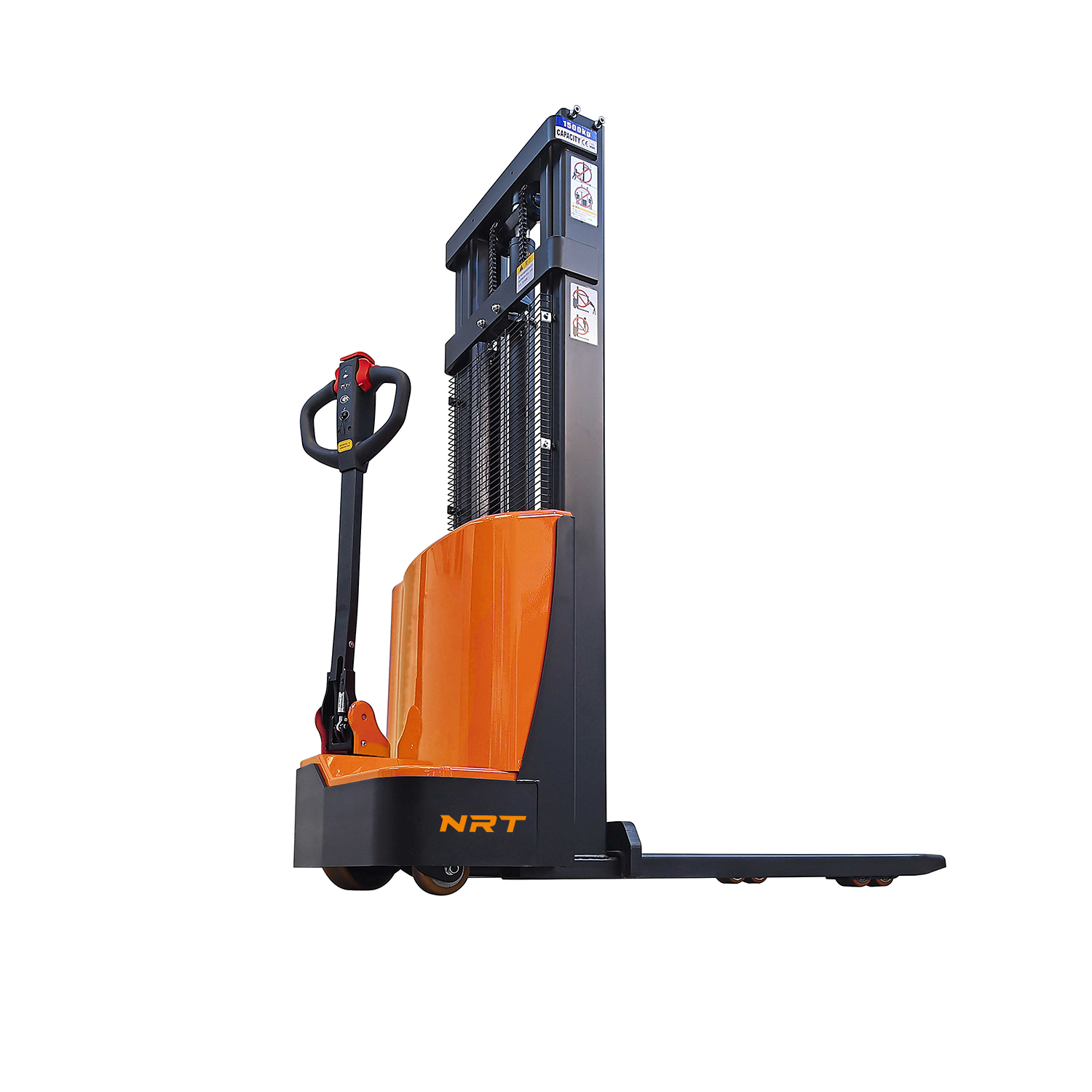
Achieving this elevation requires a duplex mast. This structural requirement impacts the overall weight and footprint of the Industrial Pallet Walkie Stacker Forklift. The addition of secondary mast channels, longer lift chains, and extended hydraulic lines increases the machine's dead weight. This added weight serves a dual purpose. It provides the necessary counterbalance for high-elevation lifts while demanding stronger floor load-bearing capacities.
Understanding the load capacity chart becomes mandatory when operating at 2910 mm. Nominal capacity refers to the maximum weight the machine can lift at ground level. Actual safe lifting capacity at maximum height will be significantly lower. This phenomenon, known as capacity derating, occurs because the center of gravity shifts upward and forward as the mast extends. A unit rated for 1500 kg at ground level may only safely lift 1000 kg at 2910 mm.
High-lift applications demand strictly level, defect-free concrete floors. Even minor floor gradients, expansion joint gaps, or surface defects become magnified when a heavy load is suspended nearly three meters in the air. Operating a fully extended stacker on uneven ground drastically increases the risk of lateral tip-overs. Facility managers must audit floor conditions before specifying a 2910 mm lift height.
Operating at 2910 mm requires operators to rely heavily on their training and depth perception. At nearly three meters in the air, minor misalignments between the forks and the pallet pockets can lead to pushed pallets or dropped loads. Operators must practice slow, deliberate hydraulic control. Jerky movements on the lift or lower controls create mast sway. Mast sway at 2910 mm destabilizes the entire machine and can cause the rear drive wheel to lift off the ground.
Inspect concrete floors for cracks, spalling, or uneven expansion joints.
Verify the exact weight of pallets destined for the third-tier racks.
Train operators to travel with the load lowered to ground level, only lifting when positioned directly in front of the rack.
Check overhead lighting fixtures to ensure they do not interfere with the mast at full extension.
The mast configuration dictates the mechanical behavior of the stacker during operation. Understanding these variations ensures proper alignment with facility constraints.
Simplex (Single Mast): Features a single stationary outer channel and an inner lifting carriage. It offers lower maintenance requirements and superior forward visibility. Simplex masts are generally limited to lower lift heights, making them the standard choice for 1510 mm configurations.
Duplex (Two-Stage Mast): Incorporates an outer channel and an inner telescoping channel. This design is required for reaching 2410 mm and 2910 mm. It introduces additional hydraulic cylinders, lift chains, and maintenance points, but provides the necessary reach while maintaining a manageable collapsed height.
Triplex (Three-Stage Mast): Utilizes three nested channels. While typically reserved for heights exceeding 2910 mm, triplex masts offer the lowest possible collapsed height relative to their maximum reach. They are essential for high-reach applications in facilities with exceptionally low doorways.
Navigating narrow aisles requires precise calculations of the equipment's physical footprint. Straddle leg design plays a pivotal role in this navigation. Fixed straddle legs offer rigid stability but limit the machine to a specific pallet size. Adjustable straddle legs provide critical flexibility, typically offering a 10-inch to 15-inch adjustment range. This mechanical adjustability allows a single machine to handle mixed pallet pools, switching between standard GMA pallets and specialized CHEP pallets without requiring a second machine.
Calculate the Right Angle Stacking Aisle (RASA) requirement before finalizing equipment selection. RASA determines the minimum aisle width required for the stacker to turn 90 degrees and insert a pallet into the racking. This calculation must factor in the mast height, the length of the load, the straddle leg width, and the machine's turning radius. Failing to calculate RASA accurately results in equipment that cannot physically maneuver within the storage aisles.
Evaluating the operational duty cycle ensures the selected equipment can survive the demands of the shift. Factoring in travel distance helps determine whether a standard walkie model suffices or if a ride-on platform model is necessary. Frequent, long-distance warehouse runs cause operator fatigue. A fold-down ride-on platform mitigates this issue and increases throughput.
Lifting heavier loads to higher elevations, particularly up to 2910 mm, significantly increases the amp-hour draw on the battery system. The hydraulic pump requires substantial electrical energy to push fluid into the lift cylinders against gravity. Evaluate battery options based on shift length and lift frequency. Absorbent Glass Mat (AGM) batteries provide reliable power for light to medium duty cycles. Lithium-ion batteries deliver sustained voltage, faster charging times, and zero maintenance requirements. They work best for high-frequency, multi-shift operations.
Battery Type | Best Application | Maintenance Requirement | Charging Profile |
|---|---|---|---|
Lead-Acid | Single-shift operations, lower budget | High (watering, equalizing) | 8 hours charge, 8 hours cool down |
AGM (Absorbent Glass Mat) | Light to medium duty, clean environments | Zero maintenance | Standard plug-in, slower charge |
Lithium-Ion | Multi-shift, high-frequency lifting | Zero maintenance | Opportunity charging allowed, fast charge |
If your facility operates a cold storage or freezer environment, your lift height requirements intersect with specialized equipment needs. Cold environments thicken hydraulic fluids, which can slow down the lifting speed of a duplex mast reaching 2910 mm. You must specify cold-storage conditioning for your stacker. This includes specialized hydraulic oil, sealed microswitches, and galvanized chassis components to prevent condensation-induced rust when moving between the freezer and ambient staging areas. The collapsed height also becomes critical here, as freezer doors often feature heavy strip curtains or rapid-roll doors with strict clearance limits.
Selecting the optimal unit from the Pallet Stacker Product Range requires analyzing long-term operational efficiency. Stackers provide a distinct mechanical advantage over full-size counterbalance forklifts by delivering equivalent load handling capabilities within a significantly smaller footprint. This compact design allows facility managers to narrow their storage aisles. You increase the total number of pallet positions within the same square footage.
The operational value delta between 1510 mm, 2410 mm, and 2910 mm models hinges on recovered vertical storage space. While higher lift capabilities require more robust mast construction and heavier chassis counterweights, the ability to utilize third-tier racking often offsets the initial equipment acquisition phase. Calculate the return on investment by quantifying the value of the additional pallet positions gained against the operational capabilities of the chosen mast height.
Higher lift heights introduce stricter maintenance and compliance protocols. Multi-stage masts require rigorous inspection of lift chains, hydraulic seals, and mast channel rollers. The duplex masts found on 2410 mm and 2910 mm units possess more moving parts than the simplex masts on 1510 mm units. You must implement a more comprehensive preventative maintenance schedule to prevent unexpected downtime.
OSHA compliance and operator training requirements remain strict for high-lift walkie stackers. Operators must understand the principles of capacity derating, the risks of elevated load transport, and the importance of floor condition awareness. Training programs must specifically address the stability dynamics of lifting loads to 2910 mm. Operators need to recognize the warning signs of hydraulic bypass or lateral instability before an incident occurs.
To finalize your equipment selection and ensure safe deployment on your warehouse floor, execute the following next steps:
Audit your facility dimensions by measuring all doorways, rack beams, and aisle widths to the exact millimeter.
Verify your pallet bottom structures to confirm whether you require a fork-over or straddle-leg configuration.
Calculate your required residual capacity at maximum height using the manufacturer's load chart for your heaviest pallets.
Request a technical specification sheet or an on-site demonstration from a certified dealer to validate maneuverability in your specific aisles.
A: The collapsed height of a 2910 mm stacker typically ranges between 1950 mm and 2100 mm, depending on the manufacturer and the specific duplex mast design. Always verify the exact collapsed height against your lowest facility doorway or overhead obstruction before procurement.
A: No. Due to capacity derating, a stacker rated for 1.5 tons at ground level will experience a reduction in safe lifting capacity as the mast extends. Always consult the data plate and load capacity chart to determine the exact safe working load at maximum elevation.
A: A simplex mast consists of a single stationary channel and offers excellent operator visibility, typically used for lower heights like 1510 mm. A duplex mast features two stages, an outer channel and an inner telescoping channel, to reach higher elevations like 2410 mm or 2910 mm.
A: Aisle width requirements depend on the Right Angle Stacking Aisle (RASA) calculation. This factors in the machine's turning radius, load length, and straddle width. Generally, walkie stackers require aisles between 2100 mm and 2600 mm for safe right-angle stacking.
A: Yes, but it requires careful specification. The stacker must have a low collapsed mast height to enter the trailer and sufficient free lift to raise the forks without extending the mast into the trailer roof. A 1510 mm simplex mast works best for this task.
A: Yes, but you must use a straddle-leg stacker. Closed-bottom pallets block the legs of a standard fork-over stacker. Straddle legs position the outriggers outside the pallet dimensions, allowing the forks to enter the pallet cleanly.
A: Adjustable straddle legs are highly recommended if your facility handles a mixed pool of pallet sizes. They typically offer a 10-inch to 15-inch adjustment range. This allows you to widen or narrow the outriggers to accommodate different pallet widths without requiring multiple machines.