Views: 0 Author: Site Editor Publish Time: 2026-09-28 Origin: Site
Expanding warehouse inventory within fixed square footage creates severe operational bottlenecks. Relying solely on manual material handling and floor-level staging limits your total storage capacity. Facility managers face a specific dilemma during warehouse upgrades or unexpected inventory surges. You must choose between optimizing horizontal load transport or adding vertical storage capabilities. You want to achieve this without the massive footprint of a full-sized sit-down forklift. The correct choice depends on strict operational criteria. You must evaluate racking heights, aisle widths, operator effort, and daily throughput volumes to keep your facility running efficiently. We will break down the exact mechanical differences, facility requirements, and operational limits of these machines. This ensures you match the right lifting equipment to your specific warehouse layout and daily material flow.
Core Functionality: Pallet jacks are engineered exclusively for ground-level horizontal transport, whereas an electric pallet stacker features a mast and hydraulic system specifically built to lift and stack pallets at varying vertical heights.
Space Utilization: An electric pallet stacker enables facilities to utilize vertical space (typically up to 15-18 feet) in narrow aisles where traditional sit-down forklifts cannot operate.
Cost vs. Capability: While an electric pallet jack requires lower initial capital and minimal maintenance, a stacker provides a higher return on investment for facilities actively scaling their vertical storage density.
Infrastructure Requirements: Stackers demand stricter floor load capacities, smoother surfaces, and specific doorway clearances due to their mast height and concentrated weight distribution.
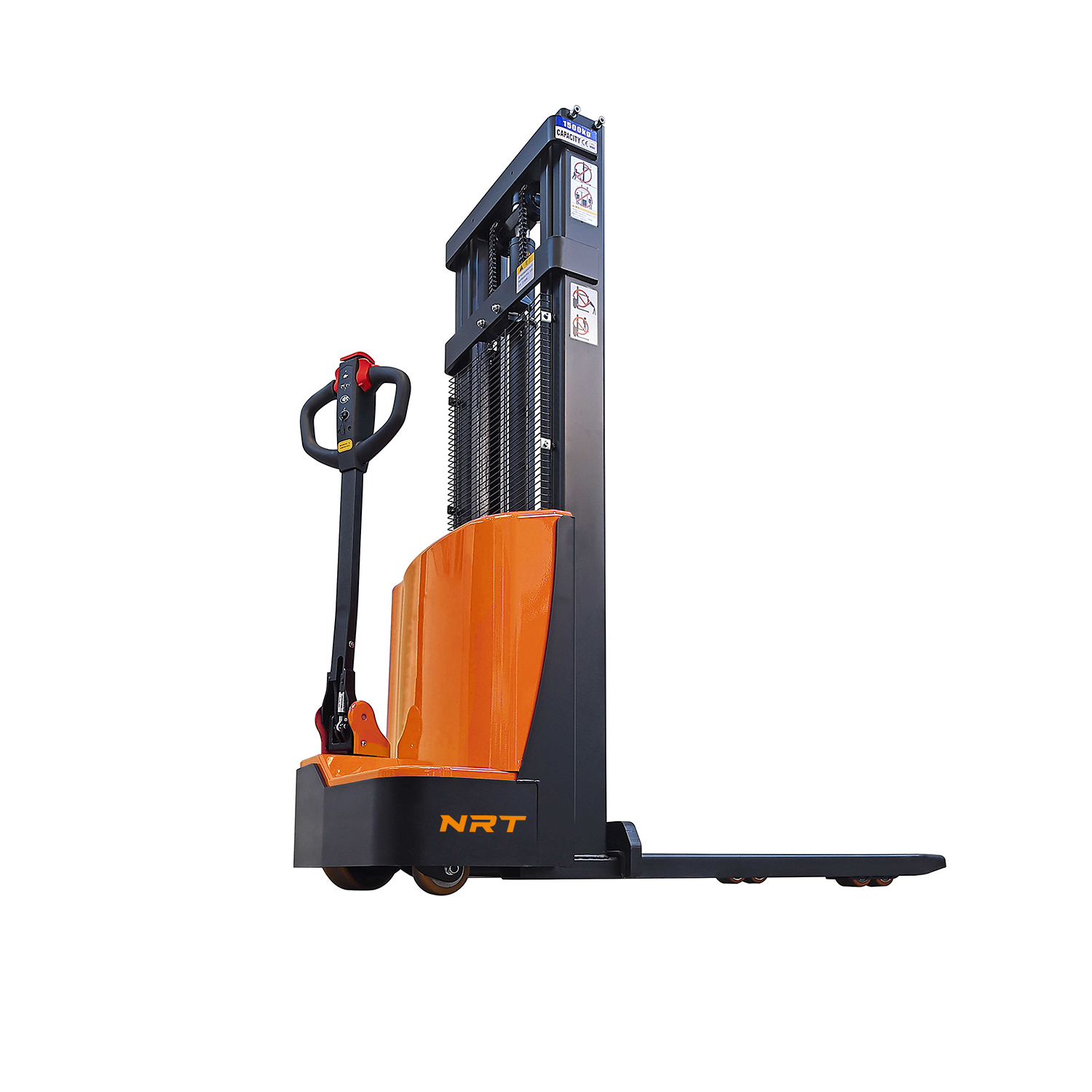
The architecture of a stacking unit centers around a robust steel chassis, a high-capacity hydraulic pump, and a vertical mast. The mast and carriage system define its primary purpose. This structure allows the forks to travel vertically along heavy-duty steel channels. Operators use these machines to elevate heavy loads safely into racking systems. The mast design varies based on required lift heights. Simplex masts offer a single stage for low lifts. Duplex masts feature two stages with free-lift capabilities, allowing the forks to rise without extending the overall mast height immediately. Triplex masts use three stages to reach maximum heights while maintaining a low collapsed profile. Heavy-duty lift chains and hydraulic cylinders work together to provide smooth elevation under heavy loads.
A Walkie Pallet Stacker fits perfectly into operations requiring short-to-medium travel distances combined with low-to-mid-level racking. Operators walk behind the unit, steering via a tiller arm equipped with lift, lower, and drive controls. The tiller head usually includes butterfly switches for forward and reverse travel, a horn, and a belly-button reversing switch that protects the operator from being pinned against racking. This configuration keeps the operator safely on the ground while providing precise control over the load. These units excel in tight stockrooms, manufacturing floors, and retail backrooms where space remains at a premium.
Different variations exist to handle specific pallet types and facility layouts. Straddle stackers feature wide outrigger legs designed to wrap around the outside of a pallet. This design supports closed-bottom pallets without crushing the bottom boards. Reach stackers incorporate a pantograph mechanism, allowing the forks to extend forward into racking. This scissor-like extension lets operators double-deep stack pallets or reach past obstacles. Counterbalance stackers eliminate the front outriggers entirely. They use heavy rear weights to stabilize the load, operating much like a traditional forklift but in a walk-behind format.
Manual pallet jacks represent the baseline of material handling mechanics. They rely almost entirely on the operator's physical input. The operator pumps the tiller handle to engage the hydraulic bottle cylinder, lifting the forks just enough to clear the floor. The lifting mechanism uses steel linkage rods and bell cranks to push the load wheels down, raising the forks. Pulling or pushing the load requires significant physical exertion, especially with pallets exceeding 2,000 pounds. Overcoming the initial rolling inertia takes a toll on the operator's back and shoulders. While highly maneuverable and mechanically simple, manual units limit productivity during long shifts due to operator fatigue.
Motorized units eliminate this physical strain. An electric drive motor propels the equipment forward and backward, while an electric pump handles the lifting mechanism. Operators simply press a button or twist a throttle on the handle. This motorized assistance transforms horizontal movement, allowing workers to transport heavy loads across massive warehouses without breaking a sweat. The transition to powered equipment drastically reduces workplace injuries related to pushing and pulling heavy weights. The internal components include a drive controller, contactors, and a battery pack, all housed within a compact chassis.
The Electric Walkie Pallet Truck serves as the industry standard for high-volume dock work. These units dominate truck loading, unloading, and long-distance horizontal staging. Their low profile allows them to easily navigate inside semi-trailers and over dock plates. Dock workers rely on them to quickly empty inbound freight and stage it on the receiving dock. Their design prioritizes speed, horizontal stability, and continuous operation over long distances. Heavy-duty models often feature a ride-on platform, allowing operators to stand during long transport runs across massive distribution centers.
Equipment design dictates lifting physics. Pallet jacks operate with minimal ground clearance. They typically lift loads only 3 to 8 inches off the ground. This minimal elevation serves a single purpose: floor clearance. By raising the pallet slightly, the equipment ensures the load does not drag on the concrete. The hydraulic pump only needs to displace a small amount of fluid to achieve this lift. This low lift height maximizes horizontal mobility and keeps the center of gravity as close to the floor as possible. It prevents tipping during sharp turns and rapid acceleration.
Stackers operate on entirely different physical principles. Their vertical lift mechanisms elevate heavy loads to multi-tier racking systems. The mast guides the carriage upward, shifting the load's center of gravity higher into the air. The hydraulic system must push fluid under extreme pressure to lift thousands of pounds vertically. This requires a significantly larger hydraulic pump and motor compared to a ground-level transport unit. Pushing a 2,500-pound load 15 feet into the air demands massive energy from the battery and places immense stress on the mast channels and lift chains.
Pallet jacks distribute weight evenly across the forks and load wheels. The load wheels sit directly underneath the pallet, supporting the weight from the bottom up. This configuration keeps the center of gravity extremely low and perfectly centered between the drive wheel and the load wheels. The stability triangle remains wide and flat against the floor. Operators can maneuver heavy pallets around tight corners without fear of the equipment tipping over. The physics naturally favor stability, even when braking hard or turning sharply.
Stackers face complex center of gravity challenges. When a stacker lifts a pallet into the air, the combined center of gravity shifts dramatically upward and forward. To prevent tipping, straddle legs extend forward to create a wide, stable footprint. The load remains within the wheelbase of the outriggers. Counterbalance models use a different approach. They rely on massive rear weights to offset the forward tipping moment. Operators must understand these stability mechanics. Turning a stacker with an elevated load, or driving it with the mast raised, can easily result in a catastrophic tip-over.
Mechanical Feature | Ground Transport Units | Vertical Stacking Units |
|---|---|---|
Primary Function | Horizontal ground transport | Vertical lifting and stacking |
Maximum Lift Height | 3 to 8 inches | Up to 15-18 feet |
Center of Gravity | Extremely low, highly stable | Shifts vertically, requires stabilization |
Hydraulic Demand | Low pressure, low volume | High pressure, high volume |
Stability Mechanism | Load wheels under forks | Outriggers or heavy counterweights |
Specific operational changes usually force an equipment upgrade. Moving into a larger industrial space often exposes the limitations of manual handling. When travel distances double, manual transport becomes too slow and physically demanding. Transitioning from floor-stacking to pallet racking represents another major trigger. Floor-stacking wastes valuable vertical space and limits inventory accessibility. Once a facility installs selective pallet racking to maximize cubic volume, ground-level equipment becomes obsolete for storage tasks. Expanding SKU counts also require denser storage solutions, pushing managers to invest in vertical lifting capabilities to organize inventory efficiently.
Facility layout dictates equipment selection. You must measure your aisles before purchasing any material handling equipment. The Right Angle Stack (RAS) dimension determines the minimum aisle width required to turn the machine 90 degrees and insert a pallet into a rack. A motorized ground transport unit typically requires a turning radius of 6 to 8 feet, depending on the fork length and the specific model. This allows operators to easily maneuver in standard warehouse aisles, tight staging areas, and inside delivery trucks. The lack of a front mast gives operators excellent visibility and a tight turning circle.
Stackers require different spatial planning. Straddle legs impact maneuverability in tight aisles. Because the outriggers sit outside the pallet dimensions, the equipment footprint is wider. A straddle stacker often requires 7 to 9 feet of aisle space to turn 90 degrees and square up to a rack. Furthermore, the racking bottom beam must be positioned high enough to allow the straddle legs to roll underneath. If the bottom beam sits flush on the floor, the straddle legs will hit the beam, preventing the forks from reaching the pallet position.
Equipment Type | Typical Aisle Requirement (RAS) | Racking Interaction |
|---|---|---|
Motorized Pallet Jack | 6 to 8 feet | Floor level only, no beam interaction |
Straddle Stacker | 7 to 9 feet | Legs must roll under bottom beam |
Counterbalance Stacker | 8 to 10 feet | No leg interference, requires wider aisle |
Reach Stacker | 7 to 9 feet | Pantograph extends into rack |
Shift lengths and daily throughput dictate your power requirements. Lead-acid batteries offer reliable power for standard single-shift operations but require regular maintenance. Technicians must water the cells weekly and perform equalizing charges to prevent sulfation. They also need dedicated charging rooms with ventilation to handle off-gassing. Lithium-ion batteries provide a massive operational advantage for multi-shift facilities. They support opportunity charging. Operators can plug the equipment in during lunch breaks or shift changes, keeping the machine running 24/7 without swapping heavy batteries or performing watering maintenance.
Energy consumption varies wildly between equipment types. Continuous horizontal travel draws relatively low amperage from the battery. A motorized jack can often run an entire shift on a single charge, even under heavy use. Vertical lifting demands high-draw hydraulic power. Pushing a heavy load 15 feet into the air drains the battery significantly faster than rolling it across the floor. Facilities performing constant high-lifting tasks must spec their batteries with higher amp-hour (Ah) ratings to avoid mid-shift power failures.
Pallet design directly impacts equipment compatibility. Standard stackers with straight forks rolling over load wheels cannot handle closed-bottom pallets. If you attempt to lift a closed-bottom pallet with standard forks, the load wheels will crush the bottom boards as they elevate. You must use straddle or counterbalance models for closed-bottom pallets. The straddle legs wrap around the outside, allowing the forks to lift the pallet from the inside without interference. This applies to CHEP pallets, block pallets with perimeter bases, and custom manufacturing skids.
Ground transport equipment avoids this issue entirely. An Electric Pallet Jack remains universally compatible with standard stringer and block pallets for ground movement. The load wheels drop through the openings in the bottom of the pallet, resting directly on the floor. When the hydraulic pump engages, the wheels push against the floor, lifting the entire pallet evenly. This universal compatibility makes them indispensable for receiving docks where inbound freight arrives on unpredictable pallet types.
Equipment complexity drives maintenance schedules. Motorized jacks feature a relatively simple mechanical layout. The primary wear parts include the polyurethane load wheels, the drive tire, and the contactors in the electrical system. The hydraulic pump only lifts a few inches, resulting in minimal wear on the seals. Technicians can easily access the drive motor and controller by removing a single cover. Routine greasing of the linkage, checking battery water levels, and periodic wheel replacements keep these units running for years with minimal downtime.
Stacking equipment carries a heavier maintenance burden due to its structural complexity. The vertical mast introduces several critical wear points. Technicians must regularly inspect and lubricate the mast chains and carriage rollers. The complex hydraulic cylinders that push the mast upward require periodic seal replacements to prevent fluid leaks. Outrigger wheels bear immense weight during high lifts and wear out faster than standard load wheels. Safety sensors, limit switches, and tilt indicators also require regular calibration to ensure safe operation at height. Ignoring mast maintenance leads to chain failure, which can drop a load from 15 feet in the air.
Safety regulations mandate specific training for powered equipment. OSHA standard 1910.178 classifies motorized jacks as powered industrial trucks. Operators must receive formal instruction, practical hands-on training, and a performance evaluation before using them. However, the training for a motorized hand truck is generally straightforward. It focuses on pedestrian awareness, speed control, proper parking procedures, and navigating dock plates safely. Operators must also learn how to perform daily pre-shift inspections, checking the horn, brakes, and reversing switches.
Operating a mast-equipped unit requires rigorous, specialized instruction. Operators must understand load stability at height. Training covers fall zones, mast sway, and the dangers of turning with an elevated load. Instructors must teach operators how to read capacity data plates, as the lifting capacity decreases as the mast extends higher. A machine rated for 3,000 pounds at ground level might only safely lift 1,500 pounds to its maximum height. Operators also learn how to safely engage racking systems without catching the forks or damaging the uprights. This advanced training is non-negotiable for maintaining a safe warehouse environment.
Warehouse flooring dictates what equipment you can safely deploy. Deploying a mast-equipped unit on uneven floors, ramps, or dock plates introduces severe risks. Even a slight floor depression causes the mast to sway. When a load is elevated 15 feet, a half-inch dip at the wheels translates to several inches of sway at the top of the mast. This sway shifts the center of gravity outside the stability triangle, causing catastrophic tipping. These machines require smooth, level concrete to operate safely. They cannot navigate steep inclines or rough asphalt yards.
Point-loading differences on warehouse concrete also matter. A low-profile jack distributes weight relatively evenly across its wheels. A heavy-masted unit concentrates massive weight onto small polyurethane outrigger wheels, especially when lifting a heavy load. This intense point-loading can crack thin concrete or damage expansion joints over time. Facility managers must verify their concrete PSI ratings and floor slab thickness before deploying heavy stacking equipment in older buildings or light-duty commercial spaces.
Ignoring collapsed mast height represents a common and costly procurement error. Facility managers often focus entirely on the maximum lift height and forget to check the machine's Overall Lowered Height (OALH). If the collapsed mast is taller than your warehouse doors, the equipment becomes trapped in one room. You must map the entire travel path of the equipment before finalizing a purchase.
Measure all pedestrian and roll-up doorways the equipment must pass through during daily operations.
Check the clearance under mezzanine overhangs, elevated walkways, and conveyor lines.
Verify the distance between the top of your highest rack and the warehouse sprinkler system to ensure fire code compliance.
Account for overhead lighting fixtures, hanging signs, and HVAC ductwork in narrow aisles.
Measure the internal height of semi-trailers if the unit will enter trucks for loading or unloading.
Physical fatigue directly impacts warehouse productivity and safety. Manual equipment relies entirely on human effort. Pulling a 2,500-pound pallet across a 200-foot warehouse floor exhausts operators quickly. The initial push or pull force required to get a heavy pallet moving strains the lower back and shoulders. As fatigue sets in, workers slow down, take longer breaks, and become prone to musculoskeletal injuries. Manual handling limits the total tonnage a single worker can move in an eight-hour shift, creating a hard ceiling on your facility's throughput.
Powered lift and drive systems eliminate this physical toll. An Electric Pallet Stacker or powered jack does the heavy lifting and pulling. Operators simply guide the machine using the tiller arm. This ergonomic benefit drastically reduces workplace injuries and workers' compensation claims. Workers maintain a consistent pace from the first hour of their shift to the last. Investing in powered equipment protects your workforce, improves employee retention, and stabilizes your daily throughput rates.
Measure your narrowest warehouse aisle and lowest doorway clearance to establish hard equipment dimension limits before reviewing spec sheets.
Audit your current pallet inventory to determine if you need straddle legs for closed-bottom pallets or standard forks for open-bottom designs.
Calculate your maximum required lift height by measuring from the floor to the top of your highest racking beam, adding six inches for lift-off clearance.
Schedule an on-site equipment demonstration to test maneuverability, floor surface compatibility, and operator comfort under actual working conditions.
A: It depends on the mast height and dock setup. Many stackers have collapsed mast heights that are too tall to enter standard semi-trailers. Additionally, their low ground clearance and outrigger legs make navigating steep dock plates or ramps dangerous. They are best kept on flat warehouse floors.
A: A walkie stacker is a pedestrian-operated machine where the user walks behind the unit. It lacks a seated cab, has a much smaller footprint, and generally features lower maximum lift heights and weight capacities compared to a traditional sit-down forklift.
A: Yes. OSHA and similar regulatory bodies classify them as powered industrial trucks. Operators must complete formal training, practical instruction, and a performance evaluation before use. This differs from manual jacks, which do not require formal powered equipment certification.
A: No. These units are designed strictly for horizontal transport. Their hydraulic systems only lift loads 3 to 8 inches off the ground to provide floor clearance. They lack the mast and vertical reach required to place pallets onto elevated shelving.
A: A straddle stacker features wide outrigger legs designed to wrap around the outside of a pallet. This design maintains stability during high lifts without requiring a massive rear counterweight. It is essential for lifting closed-bottom pallets without crushing the bottom boards.
A: Standard industry models typically handle between 3,000 and 8,000 lbs for horizontal transport. This capacity is generally higher than standard walkie stackers, which often cap out between 2,000 and 4,000 lbs due to the stability limits of lifting weights vertically.
A: You should upgrade when operator fatigue slows down throughput, when typical load weights consistently exceed 2,000 lbs, or when travel distances increase significantly. Powered units reduce musculoskeletal injuries and maintain consistent productivity throughout long shifts.